
Announcement from AnyMind (Thailand) and affiliate companies
Mar 31, 2026
Announcement
AnyMind Group



Blog
E-commerce & D2C
Dec 19, 2025
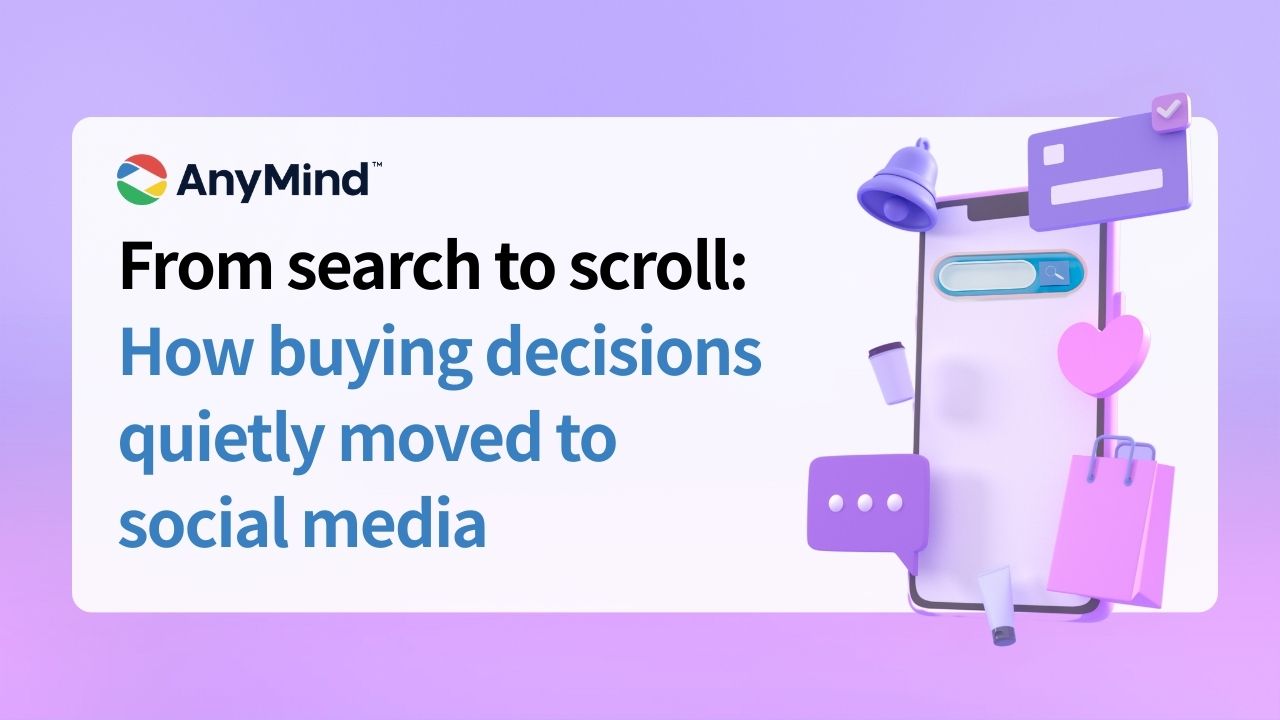
There was a time when buying something online felt intentional. You opened an e-commerce app because you needed something, the decision came first, the platform second. You searched for a specific product, compared options, read reviews, and made a choice. The process was structured, logical, and planned.
Today, that order has quietly changed. People still buy online, but the moment that triggers the decision often occurs elsewhere. At the same time, scrolling through social media, watching short videos, or joining a live stream out of curiosity. The intention to buy no longer exists at the beginning of the journey. It appears along the way.
This shift is also reflected in data. The Indonesia Digital Landscape Report 2025 highlights how social media content has become a key driver in product exploration and comparison, often shaping purchase decisions long before consumers reach a checkout page.
In the early days of e-commerce, marketplaces were destinations. People didn’t arrive there by chance. They came with a purpose and left with a product. Search bars were the starting point, and product pages existed to support rational decision-making. Price, specifications, and reviews helped consumers confirm decisions they had mostly already made. Discovery was possible, but limited. If you didn’t know what you were looking for, you rarely stayed long.
Social media introduced a different rhythm. Scrolling has no clear objective. People move from one piece of content to the next without thinking about where they’ll end up. In this environment, products began to appear not as listings, but as stories. a short video showing how something fits into daily life, a creator casually explaining why they use it, or a live session answering questions in real time.
The product is no longer something consumers actively look for, it shows up where they already are. What makes this shift powerful is timing. Products are introduced when people are relaxed, curious, and open. Not when they are actively comparing alternatives. Buying feels less like a transaction and more like a natural continuation of the moment.
Video changes how trust is formed. Instead of asking consumers to imagine how a product works, a video shows it. Movement, scale, texture, and usage become immediately clear. In live formats, hesitation fades even faster. Questions are answered as they arise, before doubt has time to grow.
There is also a human quality that static product pages rarely capture. Watching someone explain a product feels closer to a conversation than a pitch. It provides context, not just information, and context shortens decisions.
At the same time, the distance between interest and action has become much smaller. Viewers can watch, ask, react, and purchase without leaving the platform. What once required multiple steps across different channels is now often compressed into a single moment. Shopping no longer announces itself. It blends into content, entertainment, and everyday behavior.
This evolution has redefined what it means to show up in e-commerce. Being searchable is no longer enough. Brands also need to be present when people are not searching. When they are scrolling without intent, open to discovery, and driven more by curiosity than necessity.
That places new demands on content. It has to educate without overwhelming and persuade without pushing. At the same time, what happens behind the scenes matters more than ever. When content captures attention but systems are disconnected, opportunities disappear as quickly as they appear.
The brands that adapt are not necessarily louder, they are smoother. They reduce friction between interest and action until buying feels effortless. E-commerce hasn’t moved away from marketplaces, it has expanded beyond them. Buying decisions now begin earlier, happen faster, and feel less deliberate. In a scroll-driven world, relevance is no longer something consumers search for. It’s something they discover.
Want a closer look at how this behavior plays out across platforms, categories, and consumer segments in Indonesia? Download the Indonesia Digital Landscape Report 2025 to explore deeper insights on how social media, content, and commerce intersect today.

Mar 31, 2026
Announcement
AnyMind Group
Mar 30, 2026
Press Release
Influencer Marketing

Mar 27, 2026
Blog
AnyMind Group