

AnyMind Group Wins Bronze at MMA SMARTIES India 2026
Oct 15, 2026
Press Release
AnyMind Group



Blog
E-commerce & D2C
Mar 9, 2026
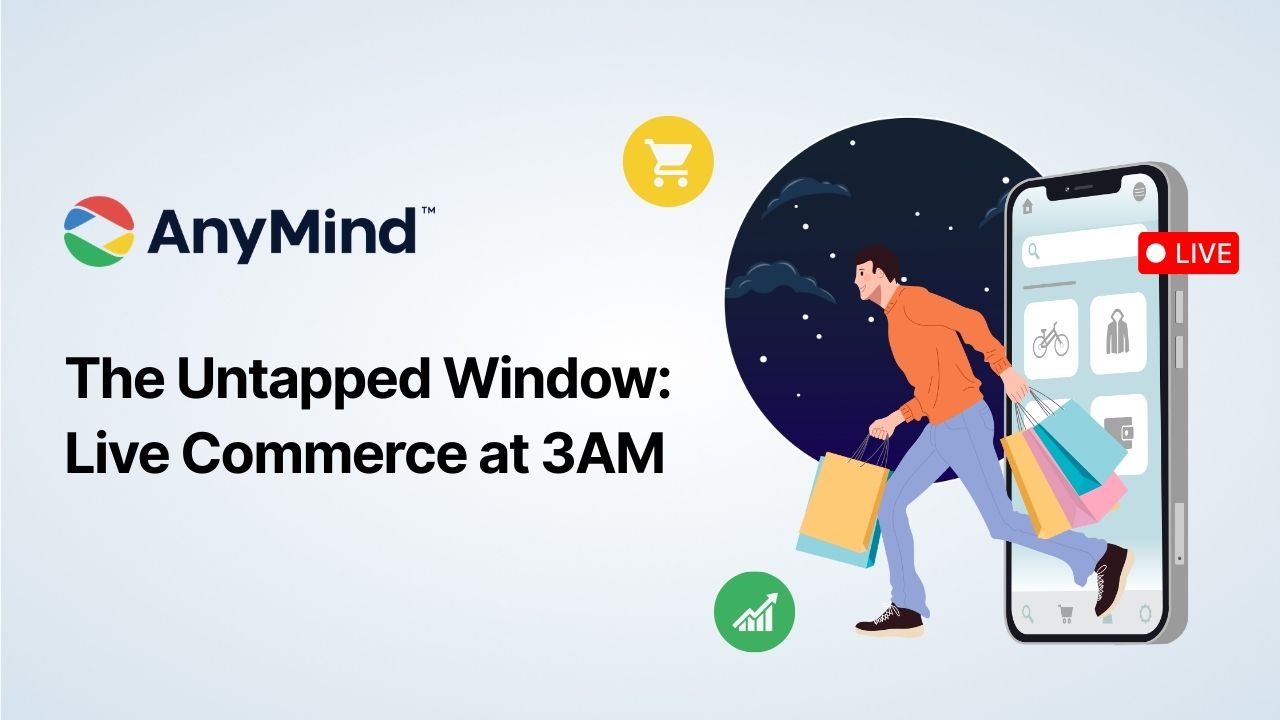
Live commerce has become one of the most powerful growth engines in e-commerce, with peak performance typically concentrated during evening hours. Most brands go live between 7PM and 11PM, capitalizing on after-work traffic and campaign-driven sales moments like 11.11 or platform mega days. Nighttime has consistently proven to generate strong engagement and impulse purchases, especially when layered with flash deals and limited-time promotions.
Yet while brands compete intensely during these peak hours, there is an overlooked window that remains largely unattended: the midnight “ghost cart” period.
Platforms such as TikTok and Shopee do not sleep. Their algorithms continue to surface content to active users throughout the night. While marketing teams log off, traffic does not.
The question is no longer whether there is activity at 3AM. The question is: who is there to convert it?
Modern consumers expect instant answers. When a shopper asks, “Is this in stock?” or “Does this fit true to size?”, a delayed response can mean an abandoned cart. The reality is that traditional live commerce relies heavily on human hosts, and staffing a 24-hour livestream operation is both expensive and unsustainable. No human host can consistently sell with energy and accuracy around the clock. Fatigue affects performance, and maintaining a full night-shift team strains both budget and operations.
This is where thehybrid AI-human model becomes critical. Human hosts remain essential during peak hours, where emotion, storytelling, and high-energy engagement drive traffic spikes. During non-peak hours, AI avatars can seamlessly take over, demonstrating products, answering frequently asked questions in seconds, and maintaining real-time interaction without fatigue.
The zero lead-time factor becomes especially important at night. AI responds instantly, preventing users from closing the app or moving to a competitor while waiting for clarification. Instead of replacing human hosts, AI removes the operational bottleneck that has historically made 24-hour live commerce unrealistic.
To answer this, we must first understand who midnight shoppers are.
Late-night buyers are not simply casual browsers. Many behave like impulse-driven shoppers responding to immediate moments of need. Night-shift workers, parents awake with newborns, and digital-native Gen Z consumers often integrate online shopping into their late-night routines. When something comes to mind at 2 or 3AM, they are more likely to act on it right away.
These purchases tend to skew toward lower-consideration products, items that don’t require long comparisons or planning. A dishwasher they’ve been meaning to replace, skincare they’ve run out of, or a gadget they’ve been casually thinking about can quickly turn into a purchase. Larger, more deliberate buys usually wait for daytime decisions.
In markets like Malaysia and Indonesia, late-night shopping behavior is also shaped by cultural rhythms. For example, shopping peaks during Suhoor, the pre-dawn period before fasting begins. In Indonesia, traffic spikes between 3AM and 5AM, while in Malaysia it often extends from 4AM to 7AM. During this window, families prepare for fasting while simultaneously engaging in online discovery and purchasing essentials such as groceries, apparel, and electronics. While afternoon hours may generate higher absolute sales, the highest percentage uplift frequently occurs in these early-morning windows, periods that many brands leave unsupported.
Because these purchases are often driven by impulse, the decision window is short. A small doubt — about sizing, availability, or whether the product will work for their needs — can easily interrupt the moment. Answering those questions instantly can secure a conversion that would otherwise become a ghost cart. AI-powered livestream hosts are uniquely positioned to fulfill this role, bridging the trust gap by providing immediate, consistent, and accurate information.
There is also a strategic platform advantage. There is significantly less competition in the live feed at midnight. Brands that remain live face fewer competing broadcasts, increasing the probability of organic discovery among active night users. Algorithms reward consistency, and streams that operate beyond conventional hours gain incremental exposure that daytime-only sellers miss.
The only viable way to make midnight streams profitable, however, is to remove the human bottleneck. Peak hours should remain human-led, maximizing connection and energy. Off-peak hours, from midnight to early morning, can be sustained by AI avatars, extending the selling window without multiplying operational costs.
Capturing midnight revenue requires more than ambition. It requires infrastructure.
This is where AnyLive becomes a strategic enabler. AnyLive is an AI live commerce platform designed to help brands extend live commerce hours sustainably without multiplying operational costs. Rather than positioning AI as a replacement, AnyLive supports a complementary structure: human hosts drive peak-time energy and conversion surges, while AI avatars maintain presence and performance during non-peak windows.
1. Scalable live hours without fatigue: AI avatars can operate for extended hours—overnight, during non-working periods, and across multiple markets—without performance drop-offs. This transforms live commerce from an event-based activity into an always-on storefront.
2. Instant, accurate responses: Brands retain full script control, ensuring messaging accuracy while AI responds instantly to common customer questions. This zero lead-time response minimizes drop-offs and improves late-night conversion probability.
3. Multi-language & market adaptability: AI avatars can operate in multiple languages and accents, enabling cross-border scalability without requiring separate night-shift teams in each market.
4. Cost efficiency with incremental GMV: By covering non-peak hours at a fraction of traditional staffing costs, brands can unlock incremental revenue that would not justify a full human crew—turning previously idle hours into profitable ones.
This approach has already delivered measurable results. BeNice implemented an all-day livestream strategy powered by AnyLive and achieved +278% GMV growth, +324.84% order growth, and an impressive +402.53% increase in buyers, demonstrating how extended AI-supported hours can significantly expand both reach and revenue.
Running livestreams at 3AM is not just about incremental sales; it is about building an always-on storefront. Maintaining consistent live presence improves platform consistency signals, which algorithms often reward by boosting discoverability during subsequent peak hours. Being active when competitors are offline strengthens long-term visibility.
Brands should not compete solely by spending more on influencers than their rivals. True competitive advantage lies in operational competence, being available whenever the customer is ready to buy. From the shopper’s perspective, it does not matter whether a human or AI is hosting the session. What matters is that their question is answered and their problem is solved.
The hidden midnight revenue is real. The only difference between capturing it and losing it is availability.
Tonight, a simple question is worth asking: How many users are visiting your storefront while your team is asleep?
Let’s run your brand 24/7 with AI-powered live commerce that turns untapped hours into measurable GMV. Speak to our team today.

Oct 15, 2026
Press Release
AnyMind Group

Oct 13, 2026
Press Release
AnyMind Group
Oct 9, 2026
Press Release
E-commerce & D2C