

AnyMind Group enters the U.S. market
Oct 22, 2026
Press Release
AnyMind Group



Blog
Influencer Marketing
Apr 23, 2026
Across Vietnam’s rapidly evolving digital landscape, one shift is becoming increasingly clear: trust is becoming a key driver of influence.
For years, the market has been driven by reach, views, impressions, and viral moments. But as platforms mature and consumers become more discerning, influence is no longer just about visibility. It is increasingly tied to conversion, driven by credibility, relatability, and validation.
As highlighted in the State of Influence APAC 2026 report, Vietnam is emerging as a trust-driven creator economy in the region, from the platforms consumers rely on to the categories attracting the most investment.
Across APAC, influencer marketing is undergoing a broader transformation. Campaigns are becoming more performance-driven, with creators expected to contribute not just to awareness, but to measurable business outcomes.
At the same time, the relationship between audiences and creators is changing. People no longer follow creators purely for entertainment. They follow them because they feel familiar, relatable, and trustworthy.
Creators are increasingly seen as guides in the decision-making process, offering real-life experiences, simplifying choices, and providing reassurance in a crowded market.
Vietnam reflects this shift strongly. Rather than passively consuming branded content, consumers are exposed to multiple layers of content across platforms and formats in a non-linear journey. A single touchpoint is rarely enough. Decisions are shaped through repeated encounters across creators, platforms, and communities before confidence is built.
While large influencers still play a role, Vietnam shows particularly strong engagement from nano-influencers (1K–10K followers). On Facebook and TikTok, these creators achieve median engagement rates of 9.24% and 16.18% respectively – far exceeding typical benchmarks in the region.
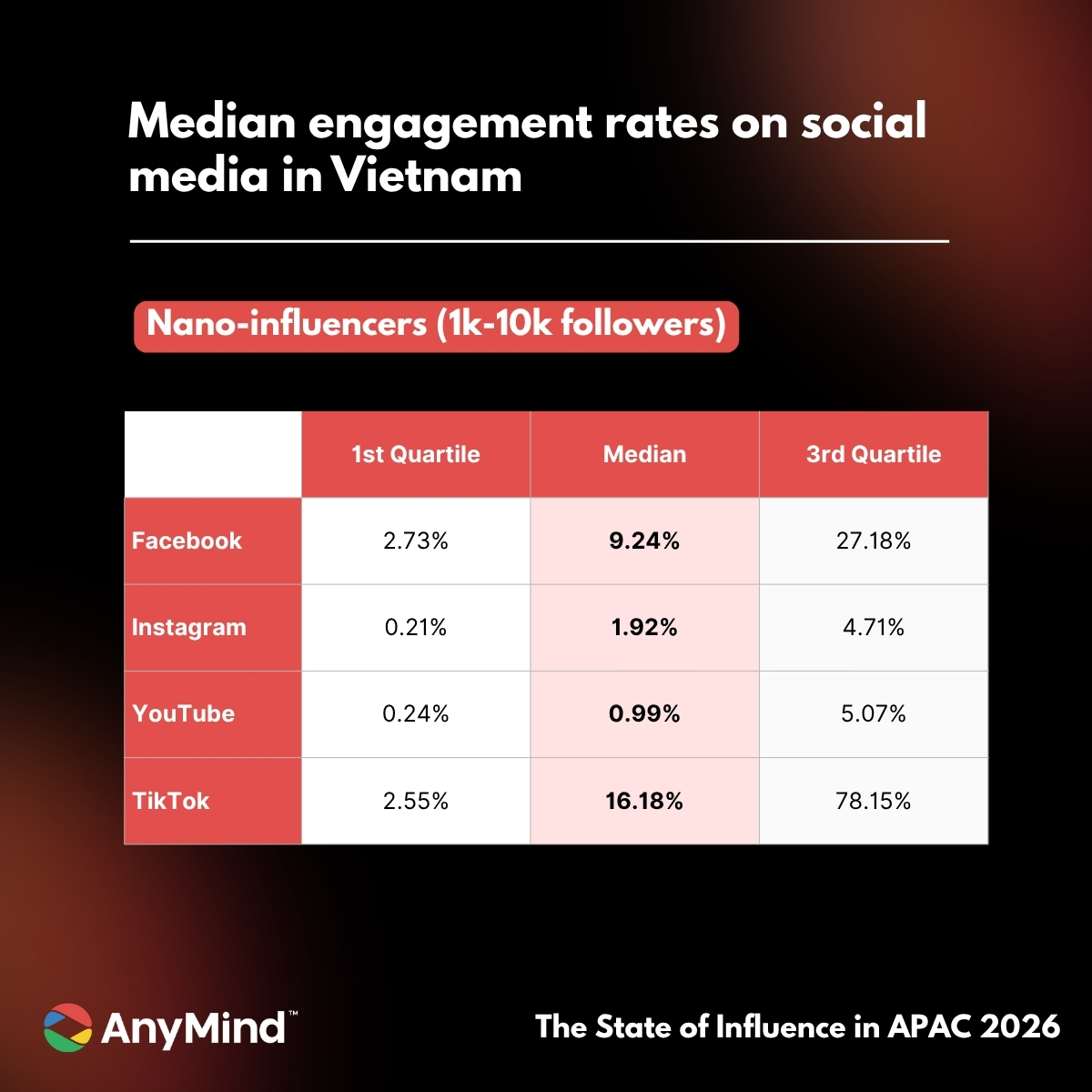
This is not simply a function of algorithm or format. It reflects a deeper behavioral pattern: trust in Vietnam is often built through proximity.
Nano-creators operate within smaller, more connected communities where interactions are more frequent, conversations are more personal, and recommendations feel like peer advice rather than advertising. In this context, influence is less about how many people you reach, and more about how strongly you are believed.
The role of trust becomes even more apparent when looking at where brands are investing. Categories such as Fashion & Beauty and Food & Beverage account for 76.3% of influencer marketing spend in Vietnam. These are highly competitive spaces which are fast-moving, saturated, and often filled with similar product claims. In such environments, consumers are trying to make the right choice among many similar options.
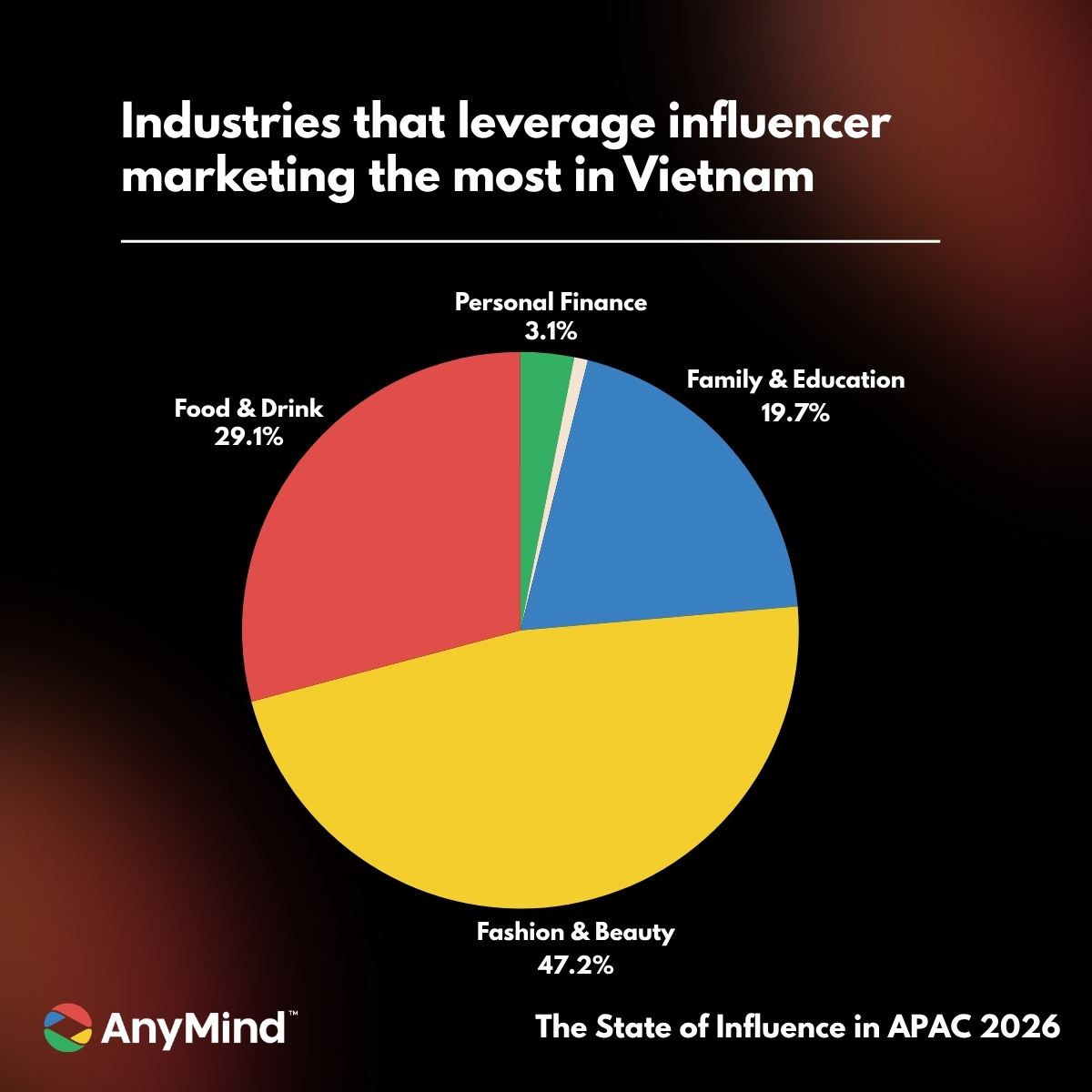
Before making a decision, users often go through a process of comparison—watching multiple reviews, cross-checking opinions across creators, and seeking real usage experiences. The journey is not just about discovery, but about shortlisting and validating options before purchase. At the same time, in categories like Family & Education, which account for 19.7% of spend, this need for validation becomes even more apparent. Decisions here are more sensitive and personal, with higher perceived risk, making credibility and reassurance critical.
In a trust-driven market, credibility cannot be built through one-off campaigns. It requires consistency, context, and community integration over time. A strong example is Cetaphil’s “3-Layer Moisture Coat” campaign in Vietnam.
Instead of relying solely on traditional advertising, the brand took a more innovative approach to connect dermatological science with Gen Z’s moisture culture. The campaign activated 30 online communities to spark curiosity on the 3-Layer Moisture Coat concept and leveraged over 100 KOLs alongside healthcare professionals to create a network of trust-driven touchpoints.
Rather than pushing a single message, Cetaphil focused on education and contextual storytelling, translating product benefits into everyday skincare routines and seasonal needs. By integrating expert voices with creator-led narratives, the brand was able to reinforce both credibility and relatability.
This approach shifted creators from simple product reviewers into long-term advocates, embedding the brand within trusted conversations rather than isolated campaigns. The impact was significant, contributing to a 159% year-over-year sales uplift, while also earning industry recognition at MMA SMARTIES 2025.
As the market becomes more validation-driven, brands need to rethink how they approach influence. It is no longer enough to generate reach. The focus must shift toward building confidence across the consumer journey, ultimately driving conversion.
This means investing in networks of creators rather than individual voices, showing up consistently across platforms, and embedding products into real-life contexts that audiences can relate to and trust. Because in Vietnam, influence does not happen in a single moment. It builds through multiple layers of exposure, reinforced by validation until it becomes strong enough to drive action.
Oct 22, 2026
Press Release
AnyMind Group
Oct 15, 2026
Press Release
AnyMind Group
Oct 13, 2026
Press Release
AnyMind Group