
AnyMind Group and D ONE D Company Limited celebrate Hone-Krasae surpassing 10 million YouTube subscribers
Sep 4, 2026
Press Release
Creator Growth



Blog
Influencer Marketing
Apr 16, 2026
For years, influencer marketing in Southeast Asia was largely treated as a brand awareness play. Brands partnered with creators to generate reach, spark conversations, and build aspirational imagery around their products.
In 2026, that is no longer the case.
Across the region, influencer marketing is evolving into a performance-driven channel, where campaigns are expected to deliver measurable outcomes such as engagement quality, traffic, and conversions. Instead of simply counting impressions or likes, brands are now evaluating creators based on their ability to move audiences closer to a purchase decision.
This shift is reflected in the growing adoption of Cost Per Result (CPR) models, where influencer budgets are directly tied to specific campaign outcomes. For marketers, this marks an important transition: influencer marketing is no longer just about visibility; it is becoming a strategic driver of business performance.
According to our State of Influence in APAC 2026 Report, influencer content now plays a critical role in the consideration phase. After consumers discover a product through ads or social media exposure, creators often provide the final trust-based signal that bridges the gap between awareness and action.
Across Southeast Asia, the influencer marketing funnel increasingly follows a discovery-to-conversion journey powered by short-form video. Platforms like TikTok have become powerful attention engines, where products are introduced through engaging and relatable content.
Brands have responded by shifting their investments accordingly. Influencer campaigns on TikTok surged from 28.35% in 2023 to 50.58% in 2025, highlighting the platform’s growing role as the primary channel for product discovery.
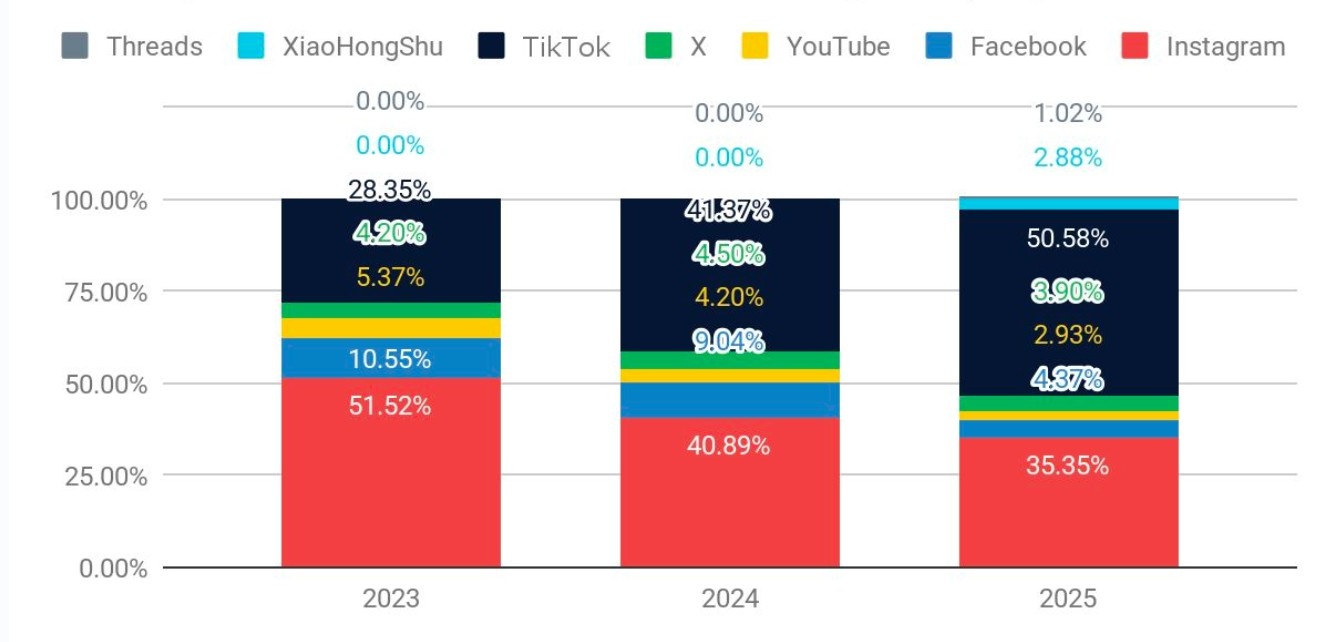
Source: The State of Influence in APAC 2026 Report
In Mandarin-speaking communities across Singapore and Malaysia, platforms like Xiaohongshu have emerged as a powerful complement to TikTok and Instagram. Unlike fast-paced discovery platforms, Xiaohongshu often captures users in the research stage of the buying journey, where consumers actively seek peer reviews, product comparisons, and lifestyle recommendations.
Together, these platforms form a powerful ecosystem where creators guide audiences from discovery to validation, and ultimately to purchase.
While the broader trend toward performance-driven influencer marketing is consistent across the region, each market behaves differently. Understanding these nuances is critical for brands looking to scale their creator strategies.
Singapore 🇸🇬
Instagram remains the dominant platform for influencer campaign investment at 71% compared to the rest. However, the strongest engagement rates—and therefore the greatest performance potential—are increasingly coming from Nano-creators on TikTok and Xiaohongshu, whose smaller but highly engaged audiences drive stronger peer-level trust.
Malaysia 🇲🇾
Brands distribute their influencer budgets relatively evenly between Instagram (48%) and TikTok (44%), creating a balanced platform mix. Meanwhile, Xiaohongshu has emerged as a high-intent discovery platform, particularly in the Lifestyle and Home categories, where it already captures over 28% of campaign spend in the Lifestyle & Home category.
Indonesia 🇮🇩
Indonesia stands out as the region’s most advanced market for performance-driven influencer marketing. 74% of campaigns are now designed with performance outcomes in mind, reflecting a shift toward measurable ROI rather than pure awareness.
Content style has also evolved. Indonesian audiences increasingly respond to raw, scenario-based storytelling, where creators present products in authentic everyday contexts rather than polished studio productions.
Thailand 🇹🇭
TikTok dominates the influencer landscape in Thailand, accounting for 66% of campaign usage. The platform’s culture of “shoppertainment” has made it the primary channel for discovery, engagement, and sales.
Philippines 🇵🇭
TikTok captures 64% of campaign volume, and the real performance opportunity lies with Nano-influencers, who consistently generate the highest median engagement rates across major platforms. Brands that adopt an always-on strategy with clusters of Nano-creators often see stronger community trust and more efficient campaign results.
Vietnam 🇻🇳
Influencer marketing thrives on a multi-platform ecosystem dominated by TikTok and Facebook, which together account for more than 90% of influencer campaign activity. TikTok drives product discovery through short-form video, while Facebook communities provide the deeper conversations and social proof that help consumers finalize their purchase decisions.
As influencer marketing becomes increasingly performance-oriented, brands are beginning to ask a bigger question: If creators can drive engagement, clicks, and product consideration, can they also drive direct sales?
This is where live commerce enters the conversation.
Across Asia, brands are experimenting with integrating creators into livestream shopping experiences, where hosts present products, respond to viewer questions, and guide audiences through purchasing decisions in real time.
Unlike traditional influencer campaigns that end after the content is published, livestream formats allow creators to interact directly with audiences, address objections instantly, and demonstrate products in action. This creates a more dynamic buying environment where consumers can move from discovery to purchase within a single session.
For Southeast Asian brands, this represents a natural evolution of influencer marketing. Instead of stopping at content creation, creators are increasingly functioning as real-time storefront hosts, helping audiences move from interest to purchase within a single interaction.
As the creator economy enters a new phase, success now depends on long-term creator partnerships over one-off sponsored posts. Metrics are shifting away from vanity indicators like likes and impressions toward revenue-linked KPIs, where influencer campaigns are evaluated based on their contribution to measurable business outcomes.
Also read: When creators are the checkout
The new rule of success in 2026 is moving from vanity to value; by leveraging market-specific creator data and performance-led models, brands can transform social influence into a scalable commerce engine.
At AnyMind Group, we work with brands across Southeast Asia to design performance-driven influencer marketing strategies, from discovery-focused campaigns to creator-led commerce initiatives.
If you’re exploring how creators can move beyond awareness and become a true engine for business growth, our team would be happy to start the conversation.

Sep 4, 2026
Press Release
Creator Growth
Sep 1, 2026
Press Release
AnyMind Group
Aug 25, 2026
Press Release
AnyMind Group