FAQ
About the Company
What is the stock code?
The Company's stock code (ticker) is 5027.
When did the company go public?
The Company went public on March 29, 2023.
What is the background of the company?
AnyMind Group was founded in Singapore in April 2016 and currently operates from 22 offices and locations across 15 markets worldwide. AnyMind Group is a technology company that provides a one-stop platform for solutions such as brand development, manufacturing management, media management, e-commerce enablement, marketing and logistics management.
What kind of business do you operate?
Enterprise Growth business:
We develop e-commerce and marketing support platforms for enterprise clients and provide them in combination with operational support. We offer one-stop support covering everything from brand design and planning, production management, e-commerce site construction and operation, marketing, live commerce, and logistics management, to AI implementation and digital transformation. In our financial results, this business domain is disclosed under two segments: Marketing business and D2C/E-Commerce business.
Publisher Growth business:
We provide advertising revenue optimization and user acquisition support utilizing our platform for publishers operating web media and mobile applications.
Creator Growth business:
We provide comprehensive support for video creators and influencers to facilitate their activities, covering content monetization, sponsor acquisition, merchandise development, and management.
We develop e-commerce and marketing support platforms for enterprise clients and provide them in combination with operational support. We offer one-stop support covering everything from brand design and planning, production management, e-commerce site construction and operation, marketing, live commerce, and logistics management, to AI implementation and digital transformation. In our financial results, this business domain is disclosed under two segments: Marketing business and D2C/E-Commerce business.
Publisher Growth business:
We provide advertising revenue optimization and user acquisition support utilizing our platform for publishers operating web media and mobile applications.
Creator Growth business:
We provide comprehensive support for video creators and influencers to facilitate their activities, covering content monetization, sponsor acquisition, merchandise development, and management.
I would like to know the details regarding the increase in employee numbers in fiscal year 2025.
Disclosed on February 13, 2026
Our employee count at the end of fiscal year 2025 was 2,163, an increase of 220 people, or approximately 11%, from the end of fiscal year 2024. The breakdown is 86 people from M&A and 134 people from organic growth. By quarter, we had an increase of 92 people in the first quarter, 12 people in the second quarter, 66 people in the third quarter, and 50 people in the fourth quarter.
The first quarter coincided with the period when changes in the external environment surrounding the Creator Growth Business occurred, but at that time, we were proceeding with hiring based on the recruitment plan formulated at the beginning of the fiscal year, on the premise of maintaining a certain personnel buffer in each business. Subsequently, in light of changes in the external environment, we revised our recruitment policy from the second quarter onwards, shifting to more disciplined hiring while still assuming investment in growth areas.
Breaking down the factors for the personnel increase, first regarding the impact of M&A, we executed three M&A deals in fiscal year 2025: an increase of 8 people in the first quarter due to the consolidation of AnyReach in March, an increase of 73 people in the third quarter due to the consolidation of Vibula in September, and an increase of 5 people in the fourth quarter due to the consolidation of NADESHIKO in October.
On the other hand, on an organic basis excluding M&A, the increase in the fourth quarter is relatively large, which is mainly due to strengthening personnel centered on the enterprise e-commerce support area, which has been performing well.
To achieve our medium-term targets, we position the improvement of business efficiency through the utilization of AI as an important premise, and it is currently progressing largely according to plan. We expect full-scale contribution to business performance from fiscal year 2026 onward, with productivity improvements expected to appear more significantly toward the latter half of the medium-term target period.
While there is a possibility of personnel increases due to M&A in fiscal year 2026 as well, our policy is to restrain organic personnel increases and achieve business growth through productivity improvement. Going forward, we will aim to achieve our medium-term targets while balancing personnel investment in growth areas with business efficiency improvements.
Our employee count at the end of fiscal year 2025 was 2,163, an increase of 220 people, or approximately 11%, from the end of fiscal year 2024. The breakdown is 86 people from M&A and 134 people from organic growth. By quarter, we had an increase of 92 people in the first quarter, 12 people in the second quarter, 66 people in the third quarter, and 50 people in the fourth quarter.
The first quarter coincided with the period when changes in the external environment surrounding the Creator Growth Business occurred, but at that time, we were proceeding with hiring based on the recruitment plan formulated at the beginning of the fiscal year, on the premise of maintaining a certain personnel buffer in each business. Subsequently, in light of changes in the external environment, we revised our recruitment policy from the second quarter onwards, shifting to more disciplined hiring while still assuming investment in growth areas.
Breaking down the factors for the personnel increase, first regarding the impact of M&A, we executed three M&A deals in fiscal year 2025: an increase of 8 people in the first quarter due to the consolidation of AnyReach in March, an increase of 73 people in the third quarter due to the consolidation of Vibula in September, and an increase of 5 people in the fourth quarter due to the consolidation of NADESHIKO in October.
On the other hand, on an organic basis excluding M&A, the increase in the fourth quarter is relatively large, which is mainly due to strengthening personnel centered on the enterprise e-commerce support area, which has been performing well.
To achieve our medium-term targets, we position the improvement of business efficiency through the utilization of AI as an important premise, and it is currently progressing largely according to plan. We expect full-scale contribution to business performance from fiscal year 2026 onward, with productivity improvements expected to appear more significantly toward the latter half of the medium-term target period.
While there is a possibility of personnel increases due to M&A in fiscal year 2026 as well, our policy is to restrain organic personnel increases and achieve business growth through productivity improvement. Going forward, we will aim to achieve our medium-term targets while balancing personnel investment in growth areas with business efficiency improvements.
Regarding the control of hiring, please explain how you will balance this with business growth.
Disclosed on October 1, 2025
To achieve both business growth and profitability, we are currently taking a balanced approach to our hiring activities, tailoring them to the situation of each business.
Specifically, in our operational delivery and corporate departments, the increase in personnel is being controlled on the premise of improving operational efficiency, including through the use of AI. On the other hand, we are continuing strategic hiring for front-office roles (sales and business development) in our growth businesses, as well as in our product development division, centered on the areas necessary to achieve our business plan. Furthermore, we are also working on the optimal allocation of existing personnel and promoting inter-departmental transfers based on aptitude, thereby striving to maximize the utilization of our internal human resources.
By improving productivity through this optimization of hiring and maximization of internal resources, we aim to achieve revenue growth from the next fiscal year onwards while controlling the increase in our number of employees.
To achieve both business growth and profitability, we are currently taking a balanced approach to our hiring activities, tailoring them to the situation of each business.
Specifically, in our operational delivery and corporate departments, the increase in personnel is being controlled on the premise of improving operational efficiency, including through the use of AI. On the other hand, we are continuing strategic hiring for front-office roles (sales and business development) in our growth businesses, as well as in our product development division, centered on the areas necessary to achieve our business plan. Furthermore, we are also working on the optimal allocation of existing personnel and promoting inter-departmental transfers based on aptitude, thereby striving to maximize the utilization of our internal human resources.
By improving productivity through this optimization of hiring and maximization of internal resources, we aim to achieve revenue growth from the next fiscal year onwards while controlling the increase in our number of employees.
Please tell us about your human resources strategy and the current recruitment situation.
Disclosed on October 1, 2024
Our human resources strategy is characterized by its fusion of a global outlook with local characteristics. While we have dedicated recruitment teams at each location, we also have a team overseeing global HR strategy and crossborder recruitment. This structure allows us to balance recruitment activities that meet each country's specific needs with the execution of a consistent global strategy.
In terms of competitive advantage in talent acquisition, we have a unique presence as a startup originating from Southeast Asia. We have achieved high growth while maintaining stable profitability improvement and financial soundness, along with the credibility of being a listed company. Moreover, there are very few companies with such a multinational organization and culture. We maximize this unique position to strategically and efficiently attract talent in each country who are eager to build careers in the global internet industry.
We are also strengthening knowledge sharing and talent development. For example, we conduct company-wide monthly knowledge sharing sessions and cross-departmental reporting meetings to promote the horizontal expansion of best practices. Furthermore, we aim to broaden employees' global perspectives and deepen cross-cultural understanding through the promotion of cross-border projects. We also provide diverse and advanced learning opportunities, including AI-support training programs, an internal online learning platform, and level-specific training. Going forward, we aim to establish a sustainable growth foundation by developing flexible human resource strategies that respond quickly to rapid market and technological changes.
Our human resources strategy is characterized by its fusion of a global outlook with local characteristics. While we have dedicated recruitment teams at each location, we also have a team overseeing global HR strategy and crossborder recruitment. This structure allows us to balance recruitment activities that meet each country's specific needs with the execution of a consistent global strategy.
In terms of competitive advantage in talent acquisition, we have a unique presence as a startup originating from Southeast Asia. We have achieved high growth while maintaining stable profitability improvement and financial soundness, along with the credibility of being a listed company. Moreover, there are very few companies with such a multinational organization and culture. We maximize this unique position to strategically and efficiently attract talent in each country who are eager to build careers in the global internet industry.
We are also strengthening knowledge sharing and talent development. For example, we conduct company-wide monthly knowledge sharing sessions and cross-departmental reporting meetings to promote the horizontal expansion of best practices. Furthermore, we aim to broaden employees' global perspectives and deepen cross-cultural understanding through the promotion of cross-border projects. We also provide diverse and advanced learning opportunities, including AI-support training programs, an internal online learning platform, and level-specific training. Going forward, we aim to establish a sustainable growth foundation by developing flexible human resource strategies that respond quickly to rapid market and technological changes.
About Business
What specific impact will the advancement of AI have on your business?
Disclosed on April 3, 2026
We view the advancement of AI as an opportunity for growth and profitability improvement. There are three main reasons for this.
1. "Source of Value" Difficult to Replace with Generative AI and Resilient Demand
The sources of our competitiveness are our "proprietary data" accumulated over many years and our strong "sales capabilities and global network." In our core influencer business in particular, the personal reach and impact of individuals—driven by their distinct personalities and trusted relationships—constitute the fundamental value, which we believe is difficult for AI to replicate. Precisely because AI is evolving, the distinctive value of human involvement and execution capabilities is becoming even more pronounced, and demand for our services remains resilient.
2. Opportunities to Improve Operational Efficiency
In the Enterprise Growth business especially, operational workloads were traditionally heavy, requiring headcount increases in step with business growth, therefore, the recruitment burden and rising costs were challenges. However, areas such as data management present significant opportunities for AI-driven automation and efficiency gains. By applying our operational expertise to AI, we expect to achieve meaningful productivity improvements.
3. Opportunity Creation and Product Evolution Through AI Across Business Domains
Each business division is proactively responding to changes in the operating environment and pursuing new opportunities. We will build sustainable competitive advantages through AI-integrated service evolution, for example, by deploying a hybrid live commerce solution that combines our in-house generative AI live commerce platform, "AnyLive," with human live. In addition, we are adapting to shifts in market demand, such as strengthening mobile app support within the Publisher Growth domain, an area where near-term market growth is anticipated.
We view the advancement of AI as an opportunity for growth and profitability improvement. There are three main reasons for this.
1. "Source of Value" Difficult to Replace with Generative AI and Resilient Demand
The sources of our competitiveness are our "proprietary data" accumulated over many years and our strong "sales capabilities and global network." In our core influencer business in particular, the personal reach and impact of individuals—driven by their distinct personalities and trusted relationships—constitute the fundamental value, which we believe is difficult for AI to replicate. Precisely because AI is evolving, the distinctive value of human involvement and execution capabilities is becoming even more pronounced, and demand for our services remains resilient.
2. Opportunities to Improve Operational Efficiency
In the Enterprise Growth business especially, operational workloads were traditionally heavy, requiring headcount increases in step with business growth, therefore, the recruitment burden and rising costs were challenges. However, areas such as data management present significant opportunities for AI-driven automation and efficiency gains. By applying our operational expertise to AI, we expect to achieve meaningful productivity improvements.
3. Opportunity Creation and Product Evolution Through AI Across Business Domains
Each business division is proactively responding to changes in the operating environment and pursuing new opportunities. We will build sustainable competitive advantages through AI-integrated service evolution, for example, by deploying a hybrid live commerce solution that combines our in-house generative AI live commerce platform, "AnyLive," with human live. In addition, we are adapting to shifts in market demand, such as strengthening mobile app support within the Publisher Growth domain, an area where near-term market growth is anticipated.
What are your impressions of the TikTok Shop launch in Japan? When do you expect it to start contributing to financial results?
Disclosed on April 3, 2026
Given that TikTok Shop in Japan is still in its early stages, we believe its GMV (Gross Merchandise Volume) is tracking at a reasonable scale and pace of growth. It took approximately one to two years from launch to full-scale growth acceleration in both Southeast Asia and the United States, and we expect Japan to follow a similar growth trajectory. While 2025 was a trial phase, we anticipate a growing number of major brands entering the platform in 2026, and we see significant room for market expansion.
The contribution to our financial results is limited at this point, but we expect it to reach a meaningful scale toward the second half of 2026. In Southeast Asia, by contrast, TikTok Shop has already established itself as a major e-commerce sales channel in each market and is contributing meaningfully to our results.
Importantly, what we emphasize even more is not just standalone sales on TikTok Shop, but channeling the demand created on TikTok to other e-commerce platforms and offline sales. We provide integrated support for sales across multiple channels, including e-commerce marketplaces such as Amazon and Rakuten, as well as the offline distribution network operated by SUNSMILE.
In the cross-border domain in particular, our engagements are primarily structured on a GMV-linked revenue model, where we provide comprehensive operational support across sales channels and our revenue scales with transaction volume. This means our revenue growth is driven by sales expansion across multiple channels, rather than being dependent on any single channel.
We are currently building an integrated online-to-offline sales infrastructure, including through our collaboration with SUNSMILE.
Given that TikTok Shop in Japan is still in its early stages, we believe its GMV (Gross Merchandise Volume) is tracking at a reasonable scale and pace of growth. It took approximately one to two years from launch to full-scale growth acceleration in both Southeast Asia and the United States, and we expect Japan to follow a similar growth trajectory. While 2025 was a trial phase, we anticipate a growing number of major brands entering the platform in 2026, and we see significant room for market expansion.
The contribution to our financial results is limited at this point, but we expect it to reach a meaningful scale toward the second half of 2026. In Southeast Asia, by contrast, TikTok Shop has already established itself as a major e-commerce sales channel in each market and is contributing meaningfully to our results.
Importantly, what we emphasize even more is not just standalone sales on TikTok Shop, but channeling the demand created on TikTok to other e-commerce platforms and offline sales. We provide integrated support for sales across multiple channels, including e-commerce marketplaces such as Amazon and Rakuten, as well as the offline distribution network operated by SUNSMILE.
In the cross-border domain in particular, our engagements are primarily structured on a GMV-linked revenue model, where we provide comprehensive operational support across sales channels and our revenue scales with transaction volume. This means our revenue growth is driven by sales expansion across multiple channels, rather than being dependent on any single channel.
We are currently building an integrated online-to-offline sales infrastructure, including through our collaboration with SUNSMILE.
Is there any impact on financial results from the recent situation in the Middle East?
Disclosed on April 3, 2026
We operate in certain regions of the Middle East, and while the Marketing business in those regions has been partially affected by geopolitical conditions in the region, the impact on our consolidated financial results is limited.
The first quarter typically coincides with the Ramadan period in Muslim-majority markets, during which our Middle East business tends to grow alongside rising consumer demand. However, for the current fiscal year, seasonal demand growth has been softer than usual. That said, gross profit from the Middle East region represented less than 0.5% of total consolidated gross profit in FY2025, and the impact of the current situation is confined to a portion of our operations in the region.
In addition, while there are concerns that elevated crude oil prices could lead to higher logistics costs, such costs represent less than 1% of our cost of sales, and we do not anticipate any material impact at this time.
We operate in certain regions of the Middle East, and while the Marketing business in those regions has been partially affected by geopolitical conditions in the region, the impact on our consolidated financial results is limited.
The first quarter typically coincides with the Ramadan period in Muslim-majority markets, during which our Middle East business tends to grow alongside rising consumer demand. However, for the current fiscal year, seasonal demand growth has been softer than usual. That said, gross profit from the Middle East region represented less than 0.5% of total consolidated gross profit in FY2025, and the impact of the current situation is confined to a portion of our operations in the region.
In addition, while there are concerns that elevated crude oil prices could lead to higher logistics costs, such costs represent less than 1% of our cost of sales, and we do not anticipate any material impact at this time.
Please provide the outlook for the Enterprise Growth Business going forward.
Disclosed on February 13, 2026
We position the social commerce domain as the core of our medium- to long-term growth strategy, with the Enterprise Growth Business being central to it. In 2025, gross profit in this area achieved high growth at 31.5% year-over-year.
Our strength lies in our ability to provide integrated capabilities across Asia, from social media marketing to e-commerce support. In addition, by integrating technology, data, and operations in-house, we believe we are positioned to further solidify competitive advantages even in a market environment where AI adoption is advancing.
Marketing and commerce support, including e-commerce, are strongly connected in terms of customer data accumulation and upselling opportunities, and by combining them, we create synergies that enhance customer value and profitability. Furthermore, our publisher and creator networks function as strategic assets that support the sales expansion of enterprise brands, accelerating the overall growth of the Enterprise Growth Business.
In 2025, with the rapid expansion of enterprise e-commerce support, we prioritized operational structure and personnel development, which resulted in short-term resource constraints in some areas. However, organizational development is now progressing, and from 2026 onwards, we are establishing a foundation to grow both marketing and e-commerce in a balanced manner.
Going forward, we will continue to strengthen our social commerce support structure that integrates marketing and commerce support, aiming to sustain high growth over the medium to long term.
We position the social commerce domain as the core of our medium- to long-term growth strategy, with the Enterprise Growth Business being central to it. In 2025, gross profit in this area achieved high growth at 31.5% year-over-year.
Our strength lies in our ability to provide integrated capabilities across Asia, from social media marketing to e-commerce support. In addition, by integrating technology, data, and operations in-house, we believe we are positioned to further solidify competitive advantages even in a market environment where AI adoption is advancing.
Marketing and commerce support, including e-commerce, are strongly connected in terms of customer data accumulation and upselling opportunities, and by combining them, we create synergies that enhance customer value and profitability. Furthermore, our publisher and creator networks function as strategic assets that support the sales expansion of enterprise brands, accelerating the overall growth of the Enterprise Growth Business.
In 2025, with the rapid expansion of enterprise e-commerce support, we prioritized operational structure and personnel development, which resulted in short-term resource constraints in some areas. However, organizational development is now progressing, and from 2026 onwards, we are establishing a foundation to grow both marketing and e-commerce in a balanced manner.
Going forward, we will continue to strengthen our social commerce support structure that integrates marketing and commerce support, aiming to sustain high growth over the medium to long term.
Please explain the status and future outlook for the Creator Growth Business.
Disclosed on February 13, 2026
Regarding the Creator Growth Business in fiscal year 2025, and as a result of changes in the external environment, gross profit was 2.64 billion yen, a decrease of 22.5% year-over-year.
In light of this situation, to strengthen the Enterprise Growth Business over the medium to long term, we conducted a review of our support areas across the entire Creator Growth business and evaluated fields that could contribute more significantly to future profitability and business synergies.
As a result, we found that for some of the creators we had been supporting, synergies with other businesses, particularly the Enterprise Growth Business, were limited from the perspective of each region's owned characteristics and content attributes. Additionally, there were cases where, even if they were generating revenue at present, medium-term revenue growth potential was low. Furthermore, for some creators, we decided to discontinue support based on considerations such as content quality and brand compatibility.
As a result, the number of supported creators decreased from 2,101 in the third quarter of 2025 to 1,237 in the fourth quarter. On the other hand, the human and operational resources freed up by this have been reallocated to areas with high synergy potential with Enterprise Growth Business and high revenue expansion potential, such as providing support for creators with high affinity for brands and products who can contribute directly to commerce revenue generation, and the social commerce area, including live commerce.
With this reorganization of support areas, in fiscal year 2026, the Creator Growth Business alone is expected to experience a negative impact of approximately 500 million yen in operating profit due to revenue decline, but this impact is already factored into our financial forecast. On the other hand, we believe that the synergies created by concentrating resources on the Enterprise Growth Business, together with the stabilization and profitability improvements within the Creator Growth Business as it refocuses on priority growth areas, will bring medium- to long-term positive effects that exceed this.
Regarding the creators for whom our support has ended, the transition has already been completed, and at this point, we do not plan to make additional changes for similar reasons. From fiscal year 2026 onwards, we will proceed with business operations that balance profitability and growth, centering on the aforementioned priority areas after the reorganization.
Regarding the Creator Growth Business in fiscal year 2025, and as a result of changes in the external environment, gross profit was 2.64 billion yen, a decrease of 22.5% year-over-year.
In light of this situation, to strengthen the Enterprise Growth Business over the medium to long term, we conducted a review of our support areas across the entire Creator Growth business and evaluated fields that could contribute more significantly to future profitability and business synergies.
As a result, we found that for some of the creators we had been supporting, synergies with other businesses, particularly the Enterprise Growth Business, were limited from the perspective of each region's owned characteristics and content attributes. Additionally, there were cases where, even if they were generating revenue at present, medium-term revenue growth potential was low. Furthermore, for some creators, we decided to discontinue support based on considerations such as content quality and brand compatibility.
As a result, the number of supported creators decreased from 2,101 in the third quarter of 2025 to 1,237 in the fourth quarter. On the other hand, the human and operational resources freed up by this have been reallocated to areas with high synergy potential with Enterprise Growth Business and high revenue expansion potential, such as providing support for creators with high affinity for brands and products who can contribute directly to commerce revenue generation, and the social commerce area, including live commerce.
With this reorganization of support areas, in fiscal year 2026, the Creator Growth Business alone is expected to experience a negative impact of approximately 500 million yen in operating profit due to revenue decline, but this impact is already factored into our financial forecast. On the other hand, we believe that the synergies created by concentrating resources on the Enterprise Growth Business, together with the stabilization and profitability improvements within the Creator Growth Business as it refocuses on priority growth areas, will bring medium- to long-term positive effects that exceed this.
Regarding the creators for whom our support has ended, the transition has already been completed, and at this point, we do not plan to make additional changes for similar reasons. From fiscal year 2026 onwards, we will proceed with business operations that balance profitability and growth, centering on the aforementioned priority areas after the reorganization.
Please explain in detail the factors driving the significant growth of the D2C/E-commerce business.
Disclosed on November 14, 2025 (Partially updated)
The D2C/E-commerce business is divided into the Creator D2C/E-commerce business and the Enterprise D2C/E-commerce business.
The Creator D2C/E-commerce business is achieving growth by concentrating resources on high-profit brands, while the number of brands handled has remained stable. Strong performance from the fitness brand "LÝFT" and merchandise brands by managed talents such as "TAKESHITA PARADISE" is driving the growth of this business segment.
In the Enterprise D2C/E-commerce business, the number of brands is increasing, mainly in Southeast Asia. When the business began in 2022, we only offered a single solution, "AnyLogi," and our main client base consisted of small-scale clients. However, we are now focusing on acquiring and deepening relationships with large-scale clients, such as global brands. We have also significantly expanded our solution offerings, moving from providing a single solution to supporting operations for high-demand solutions like live commerce and assisting with expansion into multiple countries and marketplaces. This one-stop, end-to-end support structure has become a major factor in being chosen by large-scale clients.
As a result, we achieved high growth in Southeast Asia and Japan. The natural attrition from the expiration of contracts with small-scale clients has run its course, and the number of brands has returned to a net increase. Concurrently, due to the rising proportion of large-scale clients, revenue per brand has reached a record high.
The D2C/E-commerce business is divided into the Creator D2C/E-commerce business and the Enterprise D2C/E-commerce business.
The Creator D2C/E-commerce business is achieving growth by concentrating resources on high-profit brands, while the number of brands handled has remained stable. Strong performance from the fitness brand "LÝFT" and merchandise brands by managed talents such as "TAKESHITA PARADISE" is driving the growth of this business segment.
In the Enterprise D2C/E-commerce business, the number of brands is increasing, mainly in Southeast Asia. When the business began in 2022, we only offered a single solution, "AnyLogi," and our main client base consisted of small-scale clients. However, we are now focusing on acquiring and deepening relationships with large-scale clients, such as global brands. We have also significantly expanded our solution offerings, moving from providing a single solution to supporting operations for high-demand solutions like live commerce and assisting with expansion into multiple countries and marketplaces. This one-stop, end-to-end support structure has become a major factor in being chosen by large-scale clients.
As a result, we achieved high growth in Southeast Asia and Japan. The natural attrition from the expiration of contracts with small-scale clients has run its course, and the number of brands has returned to a net increase. Concurrently, due to the rising proportion of large-scale clients, revenue per brand has reached a record high.
Please tell us about the future growth strategy and revenue outlook for the Creator Growth Business.
Disclosed on July 2, 2025 (Partially updated)
Revenue from the Creator Growth Business is primarily classified into the following three areas:
1. Creator support centered on long-form video content
2. Creator support centered on short-form video content
3. Support for talents and artists activities other than video creators
Until the first half of 2023, 1. was the main focus, but from the second half of 2023 onward, 2. has grown significantly in addition to that, and currently 3. is experiencing growth. Following the changes in the external environment in March 2025, we have downsized and withdrawn from the short-form video domain 2. However, this has no impact on the other areas of the Creator Growth business, and we expect to maintain stable growth over the medium to long term.
In particular, to promote diversification of our revenue model, we are actively strengthening areas included in 3., such as talent and artist management, event planning, merchandise production and sales, and game production utilizing IP. These new initiatives are expected to become important pillars driving future business growth. As a concrete example, our group produced short drama channel 'shunkan seju' surpassed 60,000 TikTok followers in three months from launch, and tie-up projects are also progressing smoothly. Additionally, we have established a new label, "MUNI," which specializes in live commerce within the beauty and lifestyle sectors. Through this label, we will provide comprehensive support to our affiliated creators, from training and providing a live-streaming environment to securing advertising and event appearances.
Furthermore, within the overall creator economy market, diversification of monetization methods such as merchandise sales and fan communication is advancing, and we expect continued growth in market size. Globally, the creator economy market is predicted to grow at an annual average rate of 22.7% (1), and against this backdrop of market expansion, our business can be expected to continue steady growth. Additionally, there is significant potential for AI utilization in the creator support area, and we believe we can leverage our strengths in this regard as well.
Of note, the Creator Growth Business accounts for 18% of our group's total gross profit (fiscal year ending December 2024 results), and there have been no changes to the growth prospects or business environment for our core businesses, which since our foundation have been marketing and the D2C/EC business for enterprise clients. We will continue to aim for robust growth in these core businesses, driven by the strong demand in the Asian market.
(1) Source: Coherent Market Insights, compound annual growth rate for the global creator economy market from 2025 to 2032
Revenue from the Creator Growth Business is primarily classified into the following three areas:
1. Creator support centered on long-form video content
2. Creator support centered on short-form video content
3. Support for talents and artists activities other than video creators
Until the first half of 2023, 1. was the main focus, but from the second half of 2023 onward, 2. has grown significantly in addition to that, and currently 3. is experiencing growth. Following the changes in the external environment in March 2025, we have downsized and withdrawn from the short-form video domain 2. However, this has no impact on the other areas of the Creator Growth business, and we expect to maintain stable growth over the medium to long term.
In particular, to promote diversification of our revenue model, we are actively strengthening areas included in 3., such as talent and artist management, event planning, merchandise production and sales, and game production utilizing IP. These new initiatives are expected to become important pillars driving future business growth. As a concrete example, our group produced short drama channel 'shunkan seju' surpassed 60,000 TikTok followers in three months from launch, and tie-up projects are also progressing smoothly. Additionally, we have established a new label, "MUNI," which specializes in live commerce within the beauty and lifestyle sectors. Through this label, we will provide comprehensive support to our affiliated creators, from training and providing a live-streaming environment to securing advertising and event appearances.
Furthermore, within the overall creator economy market, diversification of monetization methods such as merchandise sales and fan communication is advancing, and we expect continued growth in market size. Globally, the creator economy market is predicted to grow at an annual average rate of 22.7% (1), and against this backdrop of market expansion, our business can be expected to continue steady growth. Additionally, there is significant potential for AI utilization in the creator support area, and we believe we can leverage our strengths in this regard as well.
Of note, the Creator Growth Business accounts for 18% of our group's total gross profit (fiscal year ending December 2024 results), and there have been no changes to the growth prospects or business environment for our core businesses, which since our foundation have been marketing and the D2C/EC business for enterprise clients. We will continue to aim for robust growth in these core businesses, driven by the strong demand in the Asian market.
(1) Source: Coherent Market Insights, compound annual growth rate for the global creator economy market from 2025 to 2032
What kind of business opportunity does the launch of TikTok Shop in Japan represent for your company? Please tell us about your specific initiatives.
Disclosed on July 2, 2025 (Partially updated)
The launch of TikTok Shop in Japan represents an extremely significant business opportunity for our company, and we believe we can establish a leading position in the social commerce area in Japan.
Our company has accumulated extensive experience and expertise overseas, particularly in Southeast Asian markets. For example, we have supported major food manufacturers in expanding sales on TikTok Shop in Indonesia, and in Thailand we have been recognized as a top-tier "Prime Partner" by TikTok Shop, demonstrating our leading social commerce support track record in Asia. These achievements are supported by our specialized solution suite in this field, including our internally developed EC management tool "AnyX" and our generative AI-powered live commerce tool "AnyLive." Furthermore, in April of this year, we announced the M&A of Vibula, a prominent live commerce company in Vietnam, strengthening our organizational structure and operational know-how while accelerating global expansion.
Based on this global foundation, we are also actively advancing specific initiatives for the Japanese market. On the product side, we announced in June 2025 that our EC management tool "AnyX" and logistics management tool "AnyLogi" would begin API integration with TikTok Shop Japan. Additionally, our live commerce tool "AnyLive" has newly added Japanese language support, expanding compatible languages to 8 languages, enabling live commerce deployment across multiple languages and regions. AnyLive is also now equipped with a new function for collecting and analyzing data during live broadcasts.
Furthermore, as we recently announced, our company has been certified as an official TikTok Shop partner in Japan, in addition to our existing partnerships in Indonesia, Malaysia, the Philippines, Thailand, and Vietnam. We have established a one-stop support system for TikTok Shop that covers everything from initial planning and account management to creator collaborations, advertising, live streaming, and logistics support. By leveraging our expertise, platform, and network cultivated in Southeast Asia, we will further support the growth of brands, creators, and sellers in the Japanese market through our TikTok Shop operational support.
In terms of business development, we are already receiving numerous inquiries from clients. In anticipation of the Japanese launch of "TikTok Shop," we announced the start of providing support services for brand companies, and from May to June, we jointly held multiple seminars with TikTok for Business regarding TikTok Shop utilization. We have attracted 50 to 100 participants each time, receiving very high interest from the market and specific consultations, and we have already begun closing the deals. Our policy is to prioritize establishing market share in the Japanese market first, and steadily develop this into a medium to long-term business pillar.
The launch of TikTok Shop in Japan represents an extremely significant business opportunity for our company, and we believe we can establish a leading position in the social commerce area in Japan.
Our company has accumulated extensive experience and expertise overseas, particularly in Southeast Asian markets. For example, we have supported major food manufacturers in expanding sales on TikTok Shop in Indonesia, and in Thailand we have been recognized as a top-tier "Prime Partner" by TikTok Shop, demonstrating our leading social commerce support track record in Asia. These achievements are supported by our specialized solution suite in this field, including our internally developed EC management tool "AnyX" and our generative AI-powered live commerce tool "AnyLive." Furthermore, in April of this year, we announced the M&A of Vibula, a prominent live commerce company in Vietnam, strengthening our organizational structure and operational know-how while accelerating global expansion.
Based on this global foundation, we are also actively advancing specific initiatives for the Japanese market. On the product side, we announced in June 2025 that our EC management tool "AnyX" and logistics management tool "AnyLogi" would begin API integration with TikTok Shop Japan. Additionally, our live commerce tool "AnyLive" has newly added Japanese language support, expanding compatible languages to 8 languages, enabling live commerce deployment across multiple languages and regions. AnyLive is also now equipped with a new function for collecting and analyzing data during live broadcasts.
Furthermore, as we recently announced, our company has been certified as an official TikTok Shop partner in Japan, in addition to our existing partnerships in Indonesia, Malaysia, the Philippines, Thailand, and Vietnam. We have established a one-stop support system for TikTok Shop that covers everything from initial planning and account management to creator collaborations, advertising, live streaming, and logistics support. By leveraging our expertise, platform, and network cultivated in Southeast Asia, we will further support the growth of brands, creators, and sellers in the Japanese market through our TikTok Shop operational support.
In terms of business development, we are already receiving numerous inquiries from clients. In anticipation of the Japanese launch of "TikTok Shop," we announced the start of providing support services for brand companies, and from May to June, we jointly held multiple seminars with TikTok for Business regarding TikTok Shop utilization. We have attracted 50 to 100 participants each time, receiving very high interest from the market and specific consultations, and we have already begun closing the deals. Our policy is to prioritize establishing market share in the Japanese market first, and steadily develop this into a medium to long-term business pillar.
Please tell us about the impact on your business from changes in US tariff policies and international situation.
Disclosed on May 14, 2025
As our business development activities and sales revenue in the US market are limited, we expect the direct impact of US tariff policies to be extremely limited. While there could be indirect effects from the risk of economic deterioration in the global economy, at present, we do not see specific signs such as reduction in marketing budgets by customers in the Asian market, and the deterioration of economic sentiment has not particularly materialized.
In our Marketing business, we have a diverse customer base of over 1,000 companies annually, and risk diversification has progressed with the revenue contribution ratio of the largest customer being less than 5.0%, so we view the impact of economic fluctuations on overall performance as limited.
On the other hand, trade within Asia may be further activated due to the impact of global trade friction, and the importance of the Asian market may be reassessed. We view this environment as a new business opportunity and will leverage our strength in having a flexible business foundation spanning multiple countries to demonstrate cross-border responsiveness and enhance our competitive advantage even amid market changes.
We will continue to develop flexible strategies while monitoring geopolitical risks and changes in the international situation, aiming for medium to long-term growth centered on the Asian market.
As our business development activities and sales revenue in the US market are limited, we expect the direct impact of US tariff policies to be extremely limited. While there could be indirect effects from the risk of economic deterioration in the global economy, at present, we do not see specific signs such as reduction in marketing budgets by customers in the Asian market, and the deterioration of economic sentiment has not particularly materialized.
In our Marketing business, we have a diverse customer base of over 1,000 companies annually, and risk diversification has progressed with the revenue contribution ratio of the largest customer being less than 5.0%, so we view the impact of economic fluctuations on overall performance as limited.
On the other hand, trade within Asia may be further activated due to the impact of global trade friction, and the importance of the Asian market may be reassessed. We view this environment as a new business opportunity and will leverage our strength in having a flexible business foundation spanning multiple countries to demonstrate cross-border responsiveness and enhance our competitive advantage even amid market changes.
We will continue to develop flexible strategies while monitoring geopolitical risks and changes in the international situation, aiming for medium to long-term growth centered on the Asian market.
Will there be no expansion into new countries or regions in the future?
Disclosed on April 2, 2025
While we are constantly considering expansion into new markets, our current focus is on prioritizing business penetration in the Asian, Indian, and Middle Eastern markets, where we believe there are sufficient opportunities and room for growth. For the time being, this is a phase of further deepening business in existing markets, and even if we do expand into Western or other emerging markets, we anticipate starting with a limited approach, such as establishing sales offices first.
On the other hand, in the medium to long term, we will carefully consider the possibility of expansion into regions outside Asia, leveraging the networks, customer base, and business models developed, while taking into account business resources.
Regarding the Chinese market, we do not currently anticipate aggressive domestic expansion in China, and the policy for China-related business is to focus on supporting outbound or inbound demand from Chinese companies.
While we are constantly considering expansion into new markets, our current focus is on prioritizing business penetration in the Asian, Indian, and Middle Eastern markets, where we believe there are sufficient opportunities and room for growth. For the time being, this is a phase of further deepening business in existing markets, and even if we do expand into Western or other emerging markets, we anticipate starting with a limited approach, such as establishing sales offices first.
On the other hand, in the medium to long term, we will carefully consider the possibility of expansion into regions outside Asia, leveraging the networks, customer base, and business models developed, while taking into account business resources.
Regarding the Chinese market, we do not currently anticipate aggressive domestic expansion in China, and the policy for China-related business is to focus on supporting outbound or inbound demand from Chinese companies.
Please tell us about the growth potential of 'AnyLive,' the new solution announced on September 25, 2024.
Disclosed on January 8, 2025
At the end of September 2024, we launched 'AnyLive,' a multilingual generative AI live commerce platform. In just a few months since its launch, we have acquired prominent clients including the 'evian' brand, known for bottled water and skincare products. In the case of the evian brand, we implemented hybrid streaming in the Thai market, combining AI models with human livestreamers, achieving 3.5 times higher revenue compared to conventional methods while reducing streaming costs by 90%.
In recent years, live commerce (an e-commerce sales solution that promotes purchases through live video streaming while introducing products and communicating with viewers in real-time) has become an important marketing method for EC sales in Southeast Asia. However, live streaming faces limitations in broadcasting hours and frequency due to issues with human resources (livestreamers) and costs. 'AnyLive,' through its use of AI models for live commerce, not only enables easy support for seven Asian languages but also allows for 24-hour live commerce streaming, including off-hours when regular human-operated live commerce would not be available.
'AnyLive' operates as part of our D2C/EC segment, and since its announcement, it has been steadily increasing new client engagements as a major solution in our B2B EC business development efforts. While we believe live commerce requires a comprehensive approach, including not only AI models but also human livestreamers and collaborations with prominent influencers, we expect the importance of AI utilization to increase further. Currently, we are primarily supporting existing clients, but moving forward, we plan to accelerate the growth of our B2B EC support business by expanding the client base for 'AnyLive.
At the end of September 2024, we launched 'AnyLive,' a multilingual generative AI live commerce platform. In just a few months since its launch, we have acquired prominent clients including the 'evian' brand, known for bottled water and skincare products. In the case of the evian brand, we implemented hybrid streaming in the Thai market, combining AI models with human livestreamers, achieving 3.5 times higher revenue compared to conventional methods while reducing streaming costs by 90%.
In recent years, live commerce (an e-commerce sales solution that promotes purchases through live video streaming while introducing products and communicating with viewers in real-time) has become an important marketing method for EC sales in Southeast Asia. However, live streaming faces limitations in broadcasting hours and frequency due to issues with human resources (livestreamers) and costs. 'AnyLive,' through its use of AI models for live commerce, not only enables easy support for seven Asian languages but also allows for 24-hour live commerce streaming, including off-hours when regular human-operated live commerce would not be available.
'AnyLive' operates as part of our D2C/EC segment, and since its announcement, it has been steadily increasing new client engagements as a major solution in our B2B EC business development efforts. While we believe live commerce requires a comprehensive approach, including not only AI models but also human livestreamers and collaborations with prominent influencers, we expect the importance of AI utilization to increase further. Currently, we are primarily supporting existing clients, but moving forward, we plan to accelerate the growth of our B2B EC support business by expanding the client base for 'AnyLive.
Are there any risks you perceive for future performance or business operations?
Disclosed August 14, 2024
We operate in rapidly changing industries, so we constantly monitor changes in the industry and market. Additionally, as we expand globally, we also face geopolitical risks. However, our diversified business structure and revenue bases across various countries allow for risk distribution at the group level. Even with temporary changes in market conditions, we can expect stable growth in the Asian economy as a whole. Therefore, we believe that we have effective risk control as a group.
In business operations, more important points are recognizing the current situation regarding market changes in each country and implementing timely responses to these changes. For this, we believe that management teams in each country are crucial. While our company has diverse management members in each country, we believe that further strengthening of these country management teams is necessary to achieve higher growth in the medium to long term.
We operate in rapidly changing industries, so we constantly monitor changes in the industry and market. Additionally, as we expand globally, we also face geopolitical risks. However, our diversified business structure and revenue bases across various countries allow for risk distribution at the group level. Even with temporary changes in market conditions, we can expect stable growth in the Asian economy as a whole. Therefore, we believe that we have effective risk control as a group.
In business operations, more important points are recognizing the current situation regarding market changes in each country and implementing timely responses to these changes. For this, we believe that management teams in each country are crucial. While our company has diverse management members in each country, we believe that further strengthening of these country management teams is necessary to achieve higher growth in the medium to long term.
What is the revenue model for each business?
Disclosed on June 28, 2023 (Partially updated)
Our business is largely divided into the Enterprise Growth area and the Partner Growth area. In the Enterprise Growth area, we mainly provide growth support to corporate brands and the Brand Commerce area can be further sectioned into Marketing and D2C/EC businesses. The Marketing business provides offerings such as influencer marketing and digital marketing. The revenue model is one in which we receive marketing fees from corporate advertisers to implement marketing activities, and the cost of sales are payments to influencers and media (web media and mobile apps).
The D2C/EC business offers multiple solutions in the e-commerce value chain, including production, ecommerce management, and logistics. In the D2C (direct-to-consumer) business for creators, we have a product sales model, in which we hold inventory and earn revenue by selling D2C products together with creators. In the business of providing e-commerce support to corporate clients, there are multiple revenue models, including a sales-sharing model in which we receive a fixed percentage of the income generated from e-commerce sales, a model in which we provide individual solutions and receive a fixed monthly fee, and, a pay-as-you-go model in which we are compensated based on shipping fees, etc. (for AnyLogi, an inventory and logistics management solution).
In the Publisher Growth business for publishers operating web media and mobile applications, and the Creator Growth business for creators such as YouTubers and TikTokers, our primary revenue model is revenue sharing based on a fixed percentage of advertising revenue. For the revenue sharing model, we recognize advertising revenue received as gross amount and the payments to publishers and creators (other than the percentage of revenue sharing) are treated as cost of sales (whether we adopt the gross or net revenue recognition depends on the structure of contracts with publishers or creators, and the increase in gross profit margin which occurred in 2022 for the creator business was due to an increase in the proportion of contracts that are treated as net amount.). In addition, we also provide support to publishers for website/mobile app UX improvement, data analysis, and other services, and some of our offerings for a fixed fee.
Our business is largely divided into the Enterprise Growth area and the Partner Growth area. In the Enterprise Growth area, we mainly provide growth support to corporate brands and the Brand Commerce area can be further sectioned into Marketing and D2C/EC businesses. The Marketing business provides offerings such as influencer marketing and digital marketing. The revenue model is one in which we receive marketing fees from corporate advertisers to implement marketing activities, and the cost of sales are payments to influencers and media (web media and mobile apps).
The D2C/EC business offers multiple solutions in the e-commerce value chain, including production, ecommerce management, and logistics. In the D2C (direct-to-consumer) business for creators, we have a product sales model, in which we hold inventory and earn revenue by selling D2C products together with creators. In the business of providing e-commerce support to corporate clients, there are multiple revenue models, including a sales-sharing model in which we receive a fixed percentage of the income generated from e-commerce sales, a model in which we provide individual solutions and receive a fixed monthly fee, and, a pay-as-you-go model in which we are compensated based on shipping fees, etc. (for AnyLogi, an inventory and logistics management solution).
In the Publisher Growth business for publishers operating web media and mobile applications, and the Creator Growth business for creators such as YouTubers and TikTokers, our primary revenue model is revenue sharing based on a fixed percentage of advertising revenue. For the revenue sharing model, we recognize advertising revenue received as gross amount and the payments to publishers and creators (other than the percentage of revenue sharing) are treated as cost of sales (whether we adopt the gross or net revenue recognition depends on the structure of contracts with publishers or creators, and the increase in gross profit margin which occurred in 2022 for the creator business was due to an increase in the proportion of contracts that are treated as net amount.). In addition, we also provide support to publishers for website/mobile app UX improvement, data analysis, and other services, and some of our offerings for a fixed fee.
Are there any other companies operating in the same business as your company?
Disclosed on June 28, 2023
Our company provides a wide range of solutions primarily in the areas of e-commerce and marketing, 1 including brand building, production management, e-commerce site development and operation, marketing, and logistics management. We have expanded our operations to 13 markets across the region, which means that there are no direct competitors in the entire business. Even when considering individual business segments, there are fewer cases of competition in the entire region of development. Usually, in each country, there are local competitors in each respective business segment separately.
Furthermore, by leveraging the benefits of scaling through global business expansion, we have invested in technologies and data utilization, provided services across Asia through cross-border operations, and offered comprehensive support along the business value chain. This distinctive positioning has led to complementary relationships with local companies in various countries, resulting in numerous cases of collaboration rather than pure competition.
Since our establishment, we have consistently invested in data and products, and we have built a strong local network and organization in each Asian market. We believe that our business foundation provides us with a competitive advantage in the respective country-specific competitive environment. We aim to continue enhancing our unique value proposition and achieve further growth in the future.
Our company provides a wide range of solutions primarily in the areas of e-commerce and marketing, 1 including brand building, production management, e-commerce site development and operation, marketing, and logistics management. We have expanded our operations to 13 markets across the region, which means that there are no direct competitors in the entire business. Even when considering individual business segments, there are fewer cases of competition in the entire region of development. Usually, in each country, there are local competitors in each respective business segment separately.
Furthermore, by leveraging the benefits of scaling through global business expansion, we have invested in technologies and data utilization, provided services across Asia through cross-border operations, and offered comprehensive support along the business value chain. This distinctive positioning has led to complementary relationships with local companies in various countries, resulting in numerous cases of collaboration rather than pure competition.
Since our establishment, we have consistently invested in data and products, and we have built a strong local network and organization in each Asian market. We believe that our business foundation provides us with a competitive advantage in the respective country-specific competitive environment. We aim to continue enhancing our unique value proposition and achieve further growth in the future.
How the Company manage a multinational organization and multinational operation.
Disclosed on June 28, 2023
We have been operating in multiple countries since our establishment, and we have worked towards establishing a structure based on multinational operations. We have built a matrix organization based on two axes, country, and business. Country managers oversee operations in each country, including local teams, and are responsible for talent management, customer relations, and addressing issues specific to local markets. Regional leaders within the business axis focus on optimizing products and operations, tackling challenges that are common globally. This matrix group structure enables us to efficiently manage our business and organization.
We have also implemented a shared accounting system and CRM system throughout the company, including the companies we acquired, and have established an environment where earnings and KPI are managed in real time by business and by country, and weekly discussions are held with the head of each business in each country to review the progress and address issues faced by each business. In addition, we conduct monthly profit analysis by business unit for each country to identify businesses that require investment and businesses that need productivity improvement, and we have a system in place to respond and discuss in a timely manner.
The culture of the entire organization is very flat, and the country managers in each country work closely with other members of the group management team to improve operations in each country through mutual information sharing. In addition, for companies that have joined the group through M&A, we will promote full business integration, including organization and structure, and will establish a reporting line for each country's corporate team in both the regional and country manager's direction. We are also working to build a structure that will allow us to have more resolution and control over each country's business from the perspective of governance.
We have been operating in multiple countries since our establishment, and we have worked towards establishing a structure based on multinational operations. We have built a matrix organization based on two axes, country, and business. Country managers oversee operations in each country, including local teams, and are responsible for talent management, customer relations, and addressing issues specific to local markets. Regional leaders within the business axis focus on optimizing products and operations, tackling challenges that are common globally. This matrix group structure enables us to efficiently manage our business and organization.
We have also implemented a shared accounting system and CRM system throughout the company, including the companies we acquired, and have established an environment where earnings and KPI are managed in real time by business and by country, and weekly discussions are held with the head of each business in each country to review the progress and address issues faced by each business. In addition, we conduct monthly profit analysis by business unit for each country to identify businesses that require investment and businesses that need productivity improvement, and we have a system in place to respond and discuss in a timely manner.
The culture of the entire organization is very flat, and the country managers in each country work closely with other members of the group management team to improve operations in each country through mutual information sharing. In addition, for companies that have joined the group through M&A, we will promote full business integration, including organization and structure, and will establish a reporting line for each country's corporate team in both the regional and country manager's direction. We are also working to build a structure that will allow us to have more resolution and control over each country's business from the perspective of governance.
Is there any seasonality in your business?
Disclosed on April 13, 2023
On page 40 of the "Business Strategies and Growth Opportunities" document disclosed on March 29, 2023, the first quarter of the year (January-March) is expected to be a low season.
The first quarter has fewer business days and operating days than other quarters due to the New Year vacation and Lunar New Year vacations, etc. Many overseas companies (corporate customers) close their books in December and concentrate their marketing investments at the end of the fiscal year, so they often do not actively conduct marketing activities during January and Feburary. As a result, earnings, especially in our Marketing and Partner Growth businesses, tend to remain at lower levels compared to the preceding quarter. In Japan, March is the end of the fiscal year for many companies, which increases marketing spending, but January and February are also low seasons in Japan, and the Company has larger overseas businesses than Japan, resulting in the first quarter of the year being a low season.
The second (April-June) and third (July-September) quarters are not particularly seasonal, but since our business is in a growth stage, sales and gross profit are expected to be higher in the third quarter than in the second quarter.
The fourth quarter (October-December) is a high season for all businesses, as marketing activities and e-commerce sales increase for Diwali, India's biggest festival in October-November, and Christmas in December, and many overseas companies have a December fiscal year end and tend to concentrate their marketing spending at the end of the fiscal year.
The quarterly distribution of gross profit for the fiscal year ending December 2022, was 20% for the first quarter, 24% for the second quarter, 25% for the third quarter, and 31% for the fourth quarter, indicating that the contribution to earnings increases towards the latter half of the year due to both seasonality and our business growth. We expect the same seasonality and trend to continue in the fiscal year ending December 2023, and beyond.
On page 40 of the "Business Strategies and Growth Opportunities" document disclosed on March 29, 2023, the first quarter of the year (January-March) is expected to be a low season.
The first quarter has fewer business days and operating days than other quarters due to the New Year vacation and Lunar New Year vacations, etc. Many overseas companies (corporate customers) close their books in December and concentrate their marketing investments at the end of the fiscal year, so they often do not actively conduct marketing activities during January and Feburary. As a result, earnings, especially in our Marketing and Partner Growth businesses, tend to remain at lower levels compared to the preceding quarter. In Japan, March is the end of the fiscal year for many companies, which increases marketing spending, but January and February are also low seasons in Japan, and the Company has larger overseas businesses than Japan, resulting in the first quarter of the year being a low season.
The second (April-June) and third (July-September) quarters are not particularly seasonal, but since our business is in a growth stage, sales and gross profit are expected to be higher in the third quarter than in the second quarter.
The fourth quarter (October-December) is a high season for all businesses, as marketing activities and e-commerce sales increase for Diwali, India's biggest festival in October-November, and Christmas in December, and many overseas companies have a December fiscal year end and tend to concentrate their marketing spending at the end of the fiscal year.
The quarterly distribution of gross profit for the fiscal year ending December 2022, was 20% for the first quarter, 24% for the second quarter, 25% for the third quarter, and 31% for the fourth quarter, indicating that the contribution to earnings increases towards the latter half of the year due to both seasonality and our business growth. We expect the same seasonality and trend to continue in the fiscal year ending December 2023, and beyond.
About Financial Results and Performance
What is the expected quarterly breakdown of the full-year operating profit plan for the fiscal year 2026?
Disclosed on April 3, 2026
We project an operating profit of 3.06 billion yen for the fiscal year ending December 2026, representing a 70% YoY increase driven primarily by the growth of the Enterprise Growth business.
Our Group's financial results typically exhibit seasonality weighted toward the second half of the fiscal year, with profit levels being lowest in Q1 and progressively increasing toward Q4. The quarterly distribution of operating profit is projected to generally follow the sequence of Q1 < Q2 < Q3 < Q4. The three companies acquired through M&A and consolidated starting in January 2026 also exhibit a similar trend.
We anticipate that the effects of productivity improvements driven by business standardization and AI utilization on a Group-wide basis will contribute more significantly in the second half than in the earlier part of the fiscal year; taking these factors into consideration, we have formulated a plan weighted toward the second half.
We project an operating profit of 3.06 billion yen for the fiscal year ending December 2026, representing a 70% YoY increase driven primarily by the growth of the Enterprise Growth business.
Our Group's financial results typically exhibit seasonality weighted toward the second half of the fiscal year, with profit levels being lowest in Q1 and progressively increasing toward Q4. The quarterly distribution of operating profit is projected to generally follow the sequence of Q1 < Q2 < Q3 < Q4. The three companies acquired through M&A and consolidated starting in January 2026 also exhibit a similar trend.
We anticipate that the effects of productivity improvements driven by business standardization and AI utilization on a Group-wide basis will contribute more significantly in the second half than in the earlier part of the fiscal year; taking these factors into consideration, we have formulated a plan weighted toward the second half.
When and to what extent will the effects of AI-driven operational efficiency and productivity improvements be reflected in financial results?
Disclosed on April 3, 2026
For generative AI-driven efficiency improvements, we initiated global process standardization in FY2025 and will enter the phase of delivering concrete results from FY2026.
In the Marketing business domain, which involves multiple operational processes, we are implementing AI-driven automation and streamlining of tasks such as proposal development and reporting analysis. Previously, multiple staff were involved in the process from business negotiations through to proposal delivery, which resulted in prolonged lead times and inconsistent quality. Through AI, we are automating key workflows while continuing to leverage our proprietary data, thereby minimizing the areas requiring manual intervention. We believe this will enable fast, high-quality proposals free from reliance on individual expertise, significantly shortening lead times and improving win rates. This model, which allows sales representatives to focus on higher value-added activities, is currently being rolled out across our global offices. In addition, we are automating processes such as invoice processing and management accounting within our administrative departments, driving operational efficiency on a company-wide basis.
Regarding the impact on financial results, our initial plan for the fiscal year assumes a moderate level of headcount growth, excluding M&A. However, by leveraging AI, we aim to keep actual headcount additions well below planned levels, which represents an upside factor relative to budget. We anticipate a full-scale contribution to financial results from the second half of FY2026 onward, with productivity improvement effects becoming more pronounced toward the latter half of our medium-term target period through 2027.
For generative AI-driven efficiency improvements, we initiated global process standardization in FY2025 and will enter the phase of delivering concrete results from FY2026.
In the Marketing business domain, which involves multiple operational processes, we are implementing AI-driven automation and streamlining of tasks such as proposal development and reporting analysis. Previously, multiple staff were involved in the process from business negotiations through to proposal delivery, which resulted in prolonged lead times and inconsistent quality. Through AI, we are automating key workflows while continuing to leverage our proprietary data, thereby minimizing the areas requiring manual intervention. We believe this will enable fast, high-quality proposals free from reliance on individual expertise, significantly shortening lead times and improving win rates. This model, which allows sales representatives to focus on higher value-added activities, is currently being rolled out across our global offices. In addition, we are automating processes such as invoice processing and management accounting within our administrative departments, driving operational efficiency on a company-wide basis.
Regarding the impact on financial results, our initial plan for the fiscal year assumes a moderate level of headcount growth, excluding M&A. However, by leveraging AI, we aim to keep actual headcount additions well below planned levels, which represents an upside factor relative to budget. We anticipate a full-scale contribution to financial results from the second half of FY2026 onward, with productivity improvement effects becoming more pronounced toward the latter half of our medium-term target period through 2027.
How achievable is the FY2026 plan for the Enterprise Growth business?
Disclosed on April 3, 2026
The Enterprise Growth business consists of the Marketing business and the D2C/E-commerce business. For the current fiscal year, we project a 57% YoY increase in revenue and a 59% YoY increase in gross profit.
The Marketing business plan for the current fiscal year (revenue: up 33% YoY; gross profit: up 27% YoY) assumes a high level of growth relative to results in the second half of the previous fiscal year. We believe the slowdown in the growth rate during that period was primarily attributable to a strategic reallocation of resources to support the rapidly growing D2C/E-commerce business, rather than a deterioration in the market environment.
With this in mind, we are pursuing the following initiatives in the current fiscal year. First, we are strengthening our sales organization through the hiring and redeployment of senior sales personnel, which is expected to be substantially completed during the first half. Second, we are improving per-capita sales productivity through AI-driven workflow automation, enabling greater sales capacity. Third, we are executing cross-selling initiatives to offer social media marketing services to our existing e-commerce support clients, capitalizing on the shift in consumer behavior from social media-driven awareness to e-commerce purchases and in-store sales.
We expect these initiatives to take effect gradually and do not anticipate a rapid recovery from the first quarter. Our assumption is that improvements will progress from the second quarter onward, with the growth rate accelerating toward the second half of the year.
Meanwhile, the D2C/E-commerce business plan for the current fiscal year (revenue: up 93% YoY; gross profit: up 116% YoY) incorporates certain buffer while reflecting the current growth trajectory. As a result, the Enterprise Growth business plan is well balanced as a whole.
The Enterprise Growth business consists of the Marketing business and the D2C/E-commerce business. For the current fiscal year, we project a 57% YoY increase in revenue and a 59% YoY increase in gross profit.
The Marketing business plan for the current fiscal year (revenue: up 33% YoY; gross profit: up 27% YoY) assumes a high level of growth relative to results in the second half of the previous fiscal year. We believe the slowdown in the growth rate during that period was primarily attributable to a strategic reallocation of resources to support the rapidly growing D2C/E-commerce business, rather than a deterioration in the market environment.
With this in mind, we are pursuing the following initiatives in the current fiscal year. First, we are strengthening our sales organization through the hiring and redeployment of senior sales personnel, which is expected to be substantially completed during the first half. Second, we are improving per-capita sales productivity through AI-driven workflow automation, enabling greater sales capacity. Third, we are executing cross-selling initiatives to offer social media marketing services to our existing e-commerce support clients, capitalizing on the shift in consumer behavior from social media-driven awareness to e-commerce purchases and in-store sales.
We expect these initiatives to take effect gradually and do not anticipate a rapid recovery from the first quarter. Our assumption is that improvements will progress from the second quarter onward, with the growth rate accelerating toward the second half of the year.
Meanwhile, the D2C/E-commerce business plan for the current fiscal year (revenue: up 93% YoY; gross profit: up 116% YoY) incorporates certain buffer while reflecting the current growth trajectory. As a result, the Enterprise Growth business plan is well balanced as a whole.
How do you evaluate the achievement rate of the full-year financial forecast for the fiscal year ending December 2025?
Disclosed on February 13, 2026
In comparison to the revised financial forecast announced in May 2025, we exceeded forecasts across profit metrics, from revenue to profit for the period.
The achievement rates for revenue and gross profit were 103.7% and 103.2%, respectively. Compared to the previous period, revenue increased by 13.0% and gross profit increased by 16.9%, achieving growth that exceeded the growth rates anticipated at the time of the revision.
Regarding operating profit, while it decreased year-over-year due to changes in the external environment affecting the Creator Growth Business, it reached 1.8 billion yen, exceeding the revised financial forecast at 103.2%. Although selling, general and administrative expenses increased, this was primarily due to increases in variable costs such as IT costs and warehouse and logistics expenses associated with the expansion of the high-growth enterprise e-commerce support business, and the operating profit margin was maintained at the forecasted level of 3.1%.
Additionally, due to the impact of foreign exchange fluctuations, we recorded a foreign exchange loss of 244 million yen as non-operating expenses for the full year. However, profit for the period attributable to owners of the parent, including these factors, reached 927 million yen, exceeding the forecast at 102.3% of the plan.
In addition, we evaluate this as a year in which we made steady progress in building a foundation for medium- to longterm growth and profitability improvement, including advances in business standardization through the internal utilization of generative AI and the expansion of the enterprise e-commerce support business.
In comparison to the revised financial forecast announced in May 2025, we exceeded forecasts across profit metrics, from revenue to profit for the period.
The achievement rates for revenue and gross profit were 103.7% and 103.2%, respectively. Compared to the previous period, revenue increased by 13.0% and gross profit increased by 16.9%, achieving growth that exceeded the growth rates anticipated at the time of the revision.
Regarding operating profit, while it decreased year-over-year due to changes in the external environment affecting the Creator Growth Business, it reached 1.8 billion yen, exceeding the revised financial forecast at 103.2%. Although selling, general and administrative expenses increased, this was primarily due to increases in variable costs such as IT costs and warehouse and logistics expenses associated with the expansion of the high-growth enterprise e-commerce support business, and the operating profit margin was maintained at the forecasted level of 3.1%.
Additionally, due to the impact of foreign exchange fluctuations, we recorded a foreign exchange loss of 244 million yen as non-operating expenses for the full year. However, profit for the period attributable to owners of the parent, including these factors, reached 927 million yen, exceeding the forecast at 102.3% of the plan.
In addition, we evaluate this as a year in which we made steady progress in building a foundation for medium- to longterm growth and profitability improvement, including advances in business standardization through the internal utilization of generative AI and the expansion of the enterprise e-commerce support business.
Please explain the business performance outlook for this fiscal year (FY2026) and the specific strategies to achieve growth.
Disclosed on February 13, 2026
For the fiscal year ending December 2026, driven by growth centered on the Enterprise Growth Business, we expect revenue of 79,110 million yen (38% increase year-over-year) and gross profit of 30,350 million yen (38% increase year-over-year). Please note that our Group's businesses exhibit seasonality weighted toward the second half of the fiscal year. Typically, the first quarter is the weakest, while performance tends to improve as we progress toward the fourth quarter.
Looking at the growth rate of gross profit, the key performance indicator for our group, by business segment, the Enterprise Growth Business is expected to increase by 59%, with a breakdown of 27% increase in the marketing business and 116% increase in the D2C/EC business. On the other hand, we anticipate a 17% decrease in the Partner Growth Business, with Publisher Growth expected to remain at the previous year's level and Creator Growth expected to decrease by 38%. By region, we expect high growth centered on Southeast Asia, as well as stable growth in Japan and other regions.
In terms of profit, while continuing personnel investment associated with business expansion, we will improve profitability by restraining personnel increases through productivity improvement and reducing the ratio of personnel costs to sales, which account for approximately half of selling, general and administrative expenses. As a result, operating profit is expected to be 3,060 million yen (70% increase year-over-year), and the operating profit margin is expected to improve from 3.1% in fiscal year 2025 to 3.9%. The breakdown of the operating profit increase is approximately 800 million yen from announced M&A deals and approximately 2.2 billion yen from organic growth of existing businesses.
We expect corporate income tax expense of 860 million yen, and profit for the period attributable to owners of the parent of 1,630 million yen (76% increase year-over-year). Note that this financial forecast assumes an exchange rate of 148 yen per US dollar on average, and incorporates a foreign exchange loss of approximately 200 million yen as foreign exchange gains/losses occurring in non-operating items.
As our business strategy, we will continue to promote the strengthening of our "enterprise growth support model utilizing e-commerce infrastructure and social data." We currently support over 1,500 companies in the Marketing business and more than 220 enterprises in the D2C/EC business, and will advance customer LTV growth and data accumulation across the customer lifecycle, from demand creation on social media to e-commerce sales expansion.
Specifically, we will first improve productivity and the value we deliver through in-house DX by leveraging generative AI and advances in our products. Second, we will expand cross-border e-commerce and integrated end-to-end social commerce support across Asia, leveraging our business foundation in 15 countries. Third, we will deepen relationships with regional enterprises operating in multiple countries and advance earnings per customer and LTV improvement by replicating successful case studies across markets.
Furthermore, as part of promoting these strategies, we will implement a strategic reorganization of the Creator Growth Business in fiscal year 2026. We will shift from a support structure centered on short-form videos to concentrate on supporting creators who can create value in social commerce, talents with high brand affinity, and live streamers with strengths in live commerce. This reorganization is expected to have a negative impact of approximately 500 million yen on operating profit in fiscal year 2026, but this is already factored into our financial forecast and is positioned as a strategic investment in anticipation of revenue expansion from 2027 onwards.
Note that there is no change to the medium-term performance targets for the fiscal year ending December 2027 announced on February 14, 2025 (revenue of 105 billion yen, gross profit of 38.5 billion yen, operating profit exceeding 6.3 billion yen, operating profit margin of 6% or more). We will advance structural improvement in profitability through accelerating growth in the Enterprise Growth Business, network reorganization, strategic M&A, and sales and operational efficiency improvements utilizing generative AI, and aim to achieve our medium-term targets.
For the fiscal year ending December 2026, driven by growth centered on the Enterprise Growth Business, we expect revenue of 79,110 million yen (38% increase year-over-year) and gross profit of 30,350 million yen (38% increase year-over-year). Please note that our Group's businesses exhibit seasonality weighted toward the second half of the fiscal year. Typically, the first quarter is the weakest, while performance tends to improve as we progress toward the fourth quarter.
Looking at the growth rate of gross profit, the key performance indicator for our group, by business segment, the Enterprise Growth Business is expected to increase by 59%, with a breakdown of 27% increase in the marketing business and 116% increase in the D2C/EC business. On the other hand, we anticipate a 17% decrease in the Partner Growth Business, with Publisher Growth expected to remain at the previous year's level and Creator Growth expected to decrease by 38%. By region, we expect high growth centered on Southeast Asia, as well as stable growth in Japan and other regions.
In terms of profit, while continuing personnel investment associated with business expansion, we will improve profitability by restraining personnel increases through productivity improvement and reducing the ratio of personnel costs to sales, which account for approximately half of selling, general and administrative expenses. As a result, operating profit is expected to be 3,060 million yen (70% increase year-over-year), and the operating profit margin is expected to improve from 3.1% in fiscal year 2025 to 3.9%. The breakdown of the operating profit increase is approximately 800 million yen from announced M&A deals and approximately 2.2 billion yen from organic growth of existing businesses.
We expect corporate income tax expense of 860 million yen, and profit for the period attributable to owners of the parent of 1,630 million yen (76% increase year-over-year). Note that this financial forecast assumes an exchange rate of 148 yen per US dollar on average, and incorporates a foreign exchange loss of approximately 200 million yen as foreign exchange gains/losses occurring in non-operating items.
As our business strategy, we will continue to promote the strengthening of our "enterprise growth support model utilizing e-commerce infrastructure and social data." We currently support over 1,500 companies in the Marketing business and more than 220 enterprises in the D2C/EC business, and will advance customer LTV growth and data accumulation across the customer lifecycle, from demand creation on social media to e-commerce sales expansion.
Specifically, we will first improve productivity and the value we deliver through in-house DX by leveraging generative AI and advances in our products. Second, we will expand cross-border e-commerce and integrated end-to-end social commerce support across Asia, leveraging our business foundation in 15 countries. Third, we will deepen relationships with regional enterprises operating in multiple countries and advance earnings per customer and LTV improvement by replicating successful case studies across markets.
Furthermore, as part of promoting these strategies, we will implement a strategic reorganization of the Creator Growth Business in fiscal year 2026. We will shift from a support structure centered on short-form videos to concentrate on supporting creators who can create value in social commerce, talents with high brand affinity, and live streamers with strengths in live commerce. This reorganization is expected to have a negative impact of approximately 500 million yen on operating profit in fiscal year 2026, but this is already factored into our financial forecast and is positioned as a strategic investment in anticipation of revenue expansion from 2027 onwards.
Note that there is no change to the medium-term performance targets for the fiscal year ending December 2027 announced on February 14, 2025 (revenue of 105 billion yen, gross profit of 38.5 billion yen, operating profit exceeding 6.3 billion yen, operating profit margin of 6% or more). We will advance structural improvement in profitability through accelerating growth in the Enterprise Growth Business, network reorganization, strategic M&A, and sales and operational efficiency improvements utilizing generative AI, and aim to achieve our medium-term targets.
You have been disclosing the growth rate excluding foreign exchange impact from FY2025 Q2. Please explain the background for this and the specific impact on your performance for FY2025 Q2.
Disclosed on August 14, 2025 (Partially updated)
The Company receives the majority of its business revenue in local currencies, and as gross profit from overseas locations accounts for approximately half of the total, financial results for revenue and gross profit on a Japanese yen basis have significant influence by foreign exchange rate fluctuations. When the Japanese yen appreciates against local currencies, the growth rate after yen conversion tends to appear lower than the underlying performance, while it tends to appear higher when the Japanese yen depreciates. For this reason, these figures have not accurately reflected the substantial growth of the business; therefore, the Company has decided to begin disclosing the growth rates for revenue and gross profit, excluding foreign exchange effects, from this quarter onward.
In FY2025 Q2, the currencies with the largest impact were the Thai baht, U.S. dollar, Singapore dollar, Indonesian rupiah, and Hong Kong dollar, followed by the Vietnamese dong, New Taiwan dollar, and Philippine peso. During this quarter, the Japanese yen appreciated YoY against most of these currencies. If this quarter's results were calculated using the exchange rates from the same period of the previous year, the YoY growth rate excluding foreign exchange effects would be +14% for revenue and +20% for gross profit. This indicates that the appreciation of the Japanese yen in FY2025 Q2 had a negative impact of approximately 5% on the yen-based gross profit growth rate. In particular, for the Enterprise Growth business (Marketing business and D2C/E-commerce business), which has demonstrated significant growth, while the YoY growth rate on a yen reporting basis was 36%, the growth rate excluding foreign exchange effects would be 42%.
Additionally, as expenses such as SG&A in each country are also incurred in local currencies, an appreciation of the Japanese yen that reduces gross profit also reduces SG&A expenses. Consequently, for financial indicators at or below operating profit, this effect is offset to a certain extent.
The Company receives the majority of its business revenue in local currencies, and as gross profit from overseas locations accounts for approximately half of the total, financial results for revenue and gross profit on a Japanese yen basis have significant influence by foreign exchange rate fluctuations. When the Japanese yen appreciates against local currencies, the growth rate after yen conversion tends to appear lower than the underlying performance, while it tends to appear higher when the Japanese yen depreciates. For this reason, these figures have not accurately reflected the substantial growth of the business; therefore, the Company has decided to begin disclosing the growth rates for revenue and gross profit, excluding foreign exchange effects, from this quarter onward.
In FY2025 Q2, the currencies with the largest impact were the Thai baht, U.S. dollar, Singapore dollar, Indonesian rupiah, and Hong Kong dollar, followed by the Vietnamese dong, New Taiwan dollar, and Philippine peso. During this quarter, the Japanese yen appreciated YoY against most of these currencies. If this quarter's results were calculated using the exchange rates from the same period of the previous year, the YoY growth rate excluding foreign exchange effects would be +14% for revenue and +20% for gross profit. This indicates that the appreciation of the Japanese yen in FY2025 Q2 had a negative impact of approximately 5% on the yen-based gross profit growth rate. In particular, for the Enterprise Growth business (Marketing business and D2C/E-commerce business), which has demonstrated significant growth, while the YoY growth rate on a yen reporting basis was 36%, the growth rate excluding foreign exchange effects would be 42%.
Additionally, as expenses such as SG&A in each country are also incurred in local currencies, an appreciation of the Japanese yen that reduces gross profit also reduces SG&A expenses. Consequently, for financial indicators at or below operating profit, this effect is offset to a certain extent.
Net income for FY2025 Q2 has decreased YoY mainly due to the impact of foreign exchange losses. Please explain the reason for these foreign exchange losses and the outlook.
Disclosed on August 14, 2025
As the Company holds foreign currency-denominated assets such as U.S. dollar deposits and accounts receivable, when exchange rates fluctuate such that Asian currencies appreciate and the U.S. dollar depreciates, foreign exchange losses are incurred as non-operating financial expenses. However, these are temporary in nature, associated with exchange rate fluctuations, and the impact on the business's fundamental earning power is considered to be limited. Therefore, beginning this quarter, the Company is disclosing adjusted net income (Note 1) for reference purposes. This figure is calculated by excluding equity compensation expenses and unrealized foreign exchange gains or losses from net income attributable to owners of the parent.
During H1 2025, the trend was an appreciation of the Japanese yen and depreciation of the U.S. dollar (The Company's month-end USD/JPY exchange rates: 156.8 at the end of December 2024, 149.8 at the end of March 2025, and 144.7 at the end of June 2025). Due to this impact, unrealized foreign exchange losses of 231 million yen (cumulative H1 total: 372 million yen) were recorded as non-operating expenses, primarily related to foreign currency-denominated assets. Consequently, the accounting-based net income attributable to owners of the parent for FY2025 Q2 was 125 million yen (cumulative H1 total: 159 million yen). On the other hand, adjusted net income (Note 1), which excludes temporary factors such as these unrealized foreign exchange losses, was 372 million yen (cumulative H1 total: 561 million yen). While foreign exchange losses may be incurred if the Japanese yen continues to appreciate, the recent trend has shifted towards depreciation of the yen. If this trend continues, foreign exchange gains will be generated instead.
(Note 1) Adjusted net income = Net income attributable to owners of the parent + Equity compensation expenses ± Unrealized foreign exchange gain/loss
As the Company holds foreign currency-denominated assets such as U.S. dollar deposits and accounts receivable, when exchange rates fluctuate such that Asian currencies appreciate and the U.S. dollar depreciates, foreign exchange losses are incurred as non-operating financial expenses. However, these are temporary in nature, associated with exchange rate fluctuations, and the impact on the business's fundamental earning power is considered to be limited. Therefore, beginning this quarter, the Company is disclosing adjusted net income (Note 1) for reference purposes. This figure is calculated by excluding equity compensation expenses and unrealized foreign exchange gains or losses from net income attributable to owners of the parent.
During H1 2025, the trend was an appreciation of the Japanese yen and depreciation of the U.S. dollar (The Company's month-end USD/JPY exchange rates: 156.8 at the end of December 2024, 149.8 at the end of March 2025, and 144.7 at the end of June 2025). Due to this impact, unrealized foreign exchange losses of 231 million yen (cumulative H1 total: 372 million yen) were recorded as non-operating expenses, primarily related to foreign currency-denominated assets. Consequently, the accounting-based net income attributable to owners of the parent for FY2025 Q2 was 125 million yen (cumulative H1 total: 159 million yen). On the other hand, adjusted net income (Note 1), which excludes temporary factors such as these unrealized foreign exchange losses, was 372 million yen (cumulative H1 total: 561 million yen). While foreign exchange losses may be incurred if the Japanese yen continues to appreciate, the recent trend has shifted towards depreciation of the yen. If this trend continues, foreign exchange gains will be generated instead.
(Note 1) Adjusted net income = Net income attributable to owners of the parent + Equity compensation expenses ± Unrealized foreign exchange gain/loss
Considering the latest downward revision to your earnings forecast, how do you assess the likelihood of achieving your mid-term targets?
Disclosed on May 14, 2025
As detailed on page 19 of the FY2025 Q1 earnings presentation released on May q4, 2025, although the current downward revision may appear to temporarily increase the hurdles toward achieving our mid-term targets, we believe that our mid-term targets remain fully achievable, considering future M&A activities and operational efficiency improvement project through the utilization of generative AI.
Firstly, the financial impact of the downward revision in our Partner Growth Business for FY2025 (including the revised foreign exchange assumptions) results in a decrease of approximately 9,497 million yen in revenue and 2,481 million yen in gross profit. Given that we anticipated an annual growth rate of roughly 20% for the Partner Growth Business, we estimate that by FY2027, this revision will result in a decrease of approximately 13,675 million yen in revenue and 3,572 million yen in gross profit compared to our mid-term targets. The impact on operating profit, accounting for reduced SG&A expenses due to foreign exchange adjustments (443 million yen), is expected to be around 3,129 million yen for FY2027. In summary, the deviation from our mid-term targets for FY2027 is anticipated to be reductions of approximately 13,675 million yen in revenue, 3,572 million yen in gross profit, and 3,129 million yen in operating profit.
However, we wish to highlight two factors that were not factored into our original mid-term targets: (1) ongoing strategic M&A activities and (2) an operational efficiency project driven by AI implementation.
(1) Ongoing Strategic M&A Activities
Since before our IPO, M&A has been a central pillar of our growth strategy. For the nine acquisitions completed prior to FY2024, the acquired companies have achieved an average revenue growth of approximately 4.4 times compared to preacquisition levels, reflecting our successful track record of integration and synergy realization.
In addition to AnyReach and Vibula, both announced in FY2025, we assume the implementation of three new M&A transactions each year for FY2026 and FY2027 (up to one transaction per quarter). Based on historical M&A results, for this simulation, each acquisition is assumed to contribute approximately 1.0 billion yen in revenue, 300 million yen in gross profit, and 70 million yen in operating profit in their first year within our group. Including AnyReach and Vibula, the estimated financial contribution from these acquisitions for FY2027 amounts to approximately 7,757 million yen in revenue, 2,928 million yen in gross profit, and 592 million yen in operating profit.
(2) AI-Driven Operational Efficiency Project
We are currently driving a significant transformation into an AI-native company, led by a dedicated team reporting directly to our CEO. This initiative encompasses standardizing business processes and implementing internally developed AI tools across all regions and business units.
Personnel expenses represent the largest portion of our SG&A costs, accounting for approximately 63% of total SG&A when including recruitment and related costs. Due to our business model, which assumes continuous hiring in line with business growth, we projected headcount growth from 2,035 full-time employees as of March 31, 2025, to 3,313 employees by the end of FY2027. Consequently, headcount-related SG&A expenses were forecasted at approximately 20,328 million yen for FY2027.
Our ongoing AI implementation has already demonstrated substantial efficiency potential—for example, in our influencer marketing business, we have broken down the processes required to execute a single project into over 200 individual steps, systematically analyzing the extent to which each step can be automated, including the use of AI tools. By aggregating the time required for each step and the time savings achievable through automation, we have identified approximately 40% efficiency improvement potential within these processes, and we believe this efficiency improvement can be achieved without negatively impacting top-line revenue growth. We have already started implementing these process improvements in Japan and key target countries, and plan to sequentially expand this improvement initiative to other business segments and additional countries. Conservatively, we estimate an overall efficiency improvement of around 15% across the company. Applying this 15% improvement, headcount could be effectively controlled at approximately 2,816 employees by FY2027 instead of the initially planned 3,313, translating into a corresponding reduction in personnel-related SG&A expenses of approximately 3,049 million yen (20,328 million yen × 15%).
Summary and Future Strategy
Combining the effects of ongoing M&A activities and AI-driven operational efficiency improvements, we project an increase of approximately 7,757 million yen in revenue, 2,928 million yen in gross profit, and 3,641 million yen in operating profit for FY2027. This anticipated increase in operating profit more than offsets the downward revision impact (13,675 million yen revenue decrease, 3,572 million yen gross profit decrease, and 3,129 million yen operating profit decrease).
Ultimately, the remaining deviation from our mid-term targets for FY2027 is limited to approximately 5,918 million yen in revenue (variance rate of 5.6%) and 644 million yen in gross profit (variance rate of 1.7%). These are achievable figures within our normal existing business growth trajectory, requiring approximately a 2% annual outperformance relative to our forecast.
The assumptions used in our scenario for M&A, AI-driven operational efficiency, and existing business growth are realistic, and we believe there is further potential for upside. While we sincerely apologize for any concerns caused by this downward revision, we remain committed to steadily growing our core businesses while proactively pursuing both M&A and AI initiatives to maximize shareholder value and returns.
As detailed on page 19 of the FY2025 Q1 earnings presentation released on May q4, 2025, although the current downward revision may appear to temporarily increase the hurdles toward achieving our mid-term targets, we believe that our mid-term targets remain fully achievable, considering future M&A activities and operational efficiency improvement project through the utilization of generative AI.
Firstly, the financial impact of the downward revision in our Partner Growth Business for FY2025 (including the revised foreign exchange assumptions) results in a decrease of approximately 9,497 million yen in revenue and 2,481 million yen in gross profit. Given that we anticipated an annual growth rate of roughly 20% for the Partner Growth Business, we estimate that by FY2027, this revision will result in a decrease of approximately 13,675 million yen in revenue and 3,572 million yen in gross profit compared to our mid-term targets. The impact on operating profit, accounting for reduced SG&A expenses due to foreign exchange adjustments (443 million yen), is expected to be around 3,129 million yen for FY2027. In summary, the deviation from our mid-term targets for FY2027 is anticipated to be reductions of approximately 13,675 million yen in revenue, 3,572 million yen in gross profit, and 3,129 million yen in operating profit.
However, we wish to highlight two factors that were not factored into our original mid-term targets: (1) ongoing strategic M&A activities and (2) an operational efficiency project driven by AI implementation.
(1) Ongoing Strategic M&A Activities
Since before our IPO, M&A has been a central pillar of our growth strategy. For the nine acquisitions completed prior to FY2024, the acquired companies have achieved an average revenue growth of approximately 4.4 times compared to preacquisition levels, reflecting our successful track record of integration and synergy realization.
In addition to AnyReach and Vibula, both announced in FY2025, we assume the implementation of three new M&A transactions each year for FY2026 and FY2027 (up to one transaction per quarter). Based on historical M&A results, for this simulation, each acquisition is assumed to contribute approximately 1.0 billion yen in revenue, 300 million yen in gross profit, and 70 million yen in operating profit in their first year within our group. Including AnyReach and Vibula, the estimated financial contribution from these acquisitions for FY2027 amounts to approximately 7,757 million yen in revenue, 2,928 million yen in gross profit, and 592 million yen in operating profit.
(2) AI-Driven Operational Efficiency Project
We are currently driving a significant transformation into an AI-native company, led by a dedicated team reporting directly to our CEO. This initiative encompasses standardizing business processes and implementing internally developed AI tools across all regions and business units.
Personnel expenses represent the largest portion of our SG&A costs, accounting for approximately 63% of total SG&A when including recruitment and related costs. Due to our business model, which assumes continuous hiring in line with business growth, we projected headcount growth from 2,035 full-time employees as of March 31, 2025, to 3,313 employees by the end of FY2027. Consequently, headcount-related SG&A expenses were forecasted at approximately 20,328 million yen for FY2027.
Our ongoing AI implementation has already demonstrated substantial efficiency potential—for example, in our influencer marketing business, we have broken down the processes required to execute a single project into over 200 individual steps, systematically analyzing the extent to which each step can be automated, including the use of AI tools. By aggregating the time required for each step and the time savings achievable through automation, we have identified approximately 40% efficiency improvement potential within these processes, and we believe this efficiency improvement can be achieved without negatively impacting top-line revenue growth. We have already started implementing these process improvements in Japan and key target countries, and plan to sequentially expand this improvement initiative to other business segments and additional countries. Conservatively, we estimate an overall efficiency improvement of around 15% across the company. Applying this 15% improvement, headcount could be effectively controlled at approximately 2,816 employees by FY2027 instead of the initially planned 3,313, translating into a corresponding reduction in personnel-related SG&A expenses of approximately 3,049 million yen (20,328 million yen × 15%).
Summary and Future Strategy
Combining the effects of ongoing M&A activities and AI-driven operational efficiency improvements, we project an increase of approximately 7,757 million yen in revenue, 2,928 million yen in gross profit, and 3,641 million yen in operating profit for FY2027. This anticipated increase in operating profit more than offsets the downward revision impact (13,675 million yen revenue decrease, 3,572 million yen gross profit decrease, and 3,129 million yen operating profit decrease).
Ultimately, the remaining deviation from our mid-term targets for FY2027 is limited to approximately 5,918 million yen in revenue (variance rate of 5.6%) and 644 million yen in gross profit (variance rate of 1.7%). These are achievable figures within our normal existing business growth trajectory, requiring approximately a 2% annual outperformance relative to our forecast.
The assumptions used in our scenario for M&A, AI-driven operational efficiency, and existing business growth are realistic, and we believe there is further potential for upside. While we sincerely apologize for any concerns caused by this downward revision, we remain committed to steadily growing our core businesses while proactively pursuing both M&A and AI initiatives to maximize shareholder value and returns.
Has there been any change in the business outlook for the next few years? Which business segments do you expect to be the key drivers of the growth?
Disclosed on January 8, 2025 (Revised with outdated information removed based on May 14, 2025 disclosure)
Our outlook remains unchanged from what we have communicated since our IPO in 2023. We believe we can continue to achieve high growth, supported by the significant growth potential in Asian markets. In particular, with Asian countries expected to experience medium to long-term macroeconomic growth driven by population increases, we anticipate sustained long-term growth in our overseas operations, especially in Southeast Asian markets, which are becoming increasingly important amid globalization.
We expect continued high growth particularly in our business for enterprise clients (Marketing segment and D2C/EC segment). In these segments, we support brand growth for enterprise clients across various industries, with a particular focus on clients who own consumer goods brands targeting individual consumers. For such clients, expansion into Asian markets is often a crucial initiative. We believe our unique capabilities and business scope provide significant differentiation from competitors and deliver high value to clients through: 1. our established support system across Asia and deep understanding of each market, 2. our technological capabilities to support visualization of data dispersed across countries, operational efficiency improvements, and generative AI implementation, and 3. our ability to provide comprehensive support from brand awareness to revenue generation throughout the marketing and EC processes support. Furthermore, beyond supporting Japanese companies' Asian expansion, we assist Asian companies from Korea, China, and Southeast Asia, as well as Western companies in their multi-country expansion. We anticipate that our addressable market size will continue to expand.
Additionally, in these enterprise brands support segments, there are a lot of M&A opportunities both domestically and internationally, and this business segment is easier to realize synergistic effects such as cross-selling to each segment's clients. Furthermore, as we grow both organically and through M&A and strengthen our support systems in each country, we believe we can create a virtuous cycle where our appeal to enterprise clients and our unique value proposition become increasingly stronger.
Moreover, we expect stable growth in our Partner Growth segment, which provides growth support for creators and publishers (operators of online media and mobile applications). These areas also represent growing markets globally, and we expect support opportunities to expand over the medium to long term as new creators and publishers emerge. In this context, our position is unique given our ability to provide global support and our technologically advantaged infrastructure and solutions. Furthermore, we can expect synergistic effects across our business portfolio in maximizing advertising demand, such as securing tie-up opportunities by leveraging our enterprise client network. By capitalizing on our competitive advantage of having extensive networks of enterprise clients, creators, and publishers across Asian countries, we aim to establish AnyMind as the go-to partner for business growth in Asia.
We also expect stable improvement in profitability. Over 50% of our SG&A expenses are personnel costs. Other expenses such as office rent and office-related costs are also linked to headcount, making the number of employees the primary driver of SG&A expenses. Operating across 15 countries and regions with multiple business lines, we need to maintain structures for acquiring and supporting local clients in each country, requiring workforce expansion as our business scale grows. However, we typically don't need to increase headcount at the same rate as revenue growth, so during periods of stable revenue growth, we can achieve gradual improvement in profitability.
We will continue to strengthen our position in Asian markets while pursuing both revenue growth and profitability.
Our outlook remains unchanged from what we have communicated since our IPO in 2023. We believe we can continue to achieve high growth, supported by the significant growth potential in Asian markets. In particular, with Asian countries expected to experience medium to long-term macroeconomic growth driven by population increases, we anticipate sustained long-term growth in our overseas operations, especially in Southeast Asian markets, which are becoming increasingly important amid globalization.
We expect continued high growth particularly in our business for enterprise clients (Marketing segment and D2C/EC segment). In these segments, we support brand growth for enterprise clients across various industries, with a particular focus on clients who own consumer goods brands targeting individual consumers. For such clients, expansion into Asian markets is often a crucial initiative. We believe our unique capabilities and business scope provide significant differentiation from competitors and deliver high value to clients through: 1. our established support system across Asia and deep understanding of each market, 2. our technological capabilities to support visualization of data dispersed across countries, operational efficiency improvements, and generative AI implementation, and 3. our ability to provide comprehensive support from brand awareness to revenue generation throughout the marketing and EC processes support. Furthermore, beyond supporting Japanese companies' Asian expansion, we assist Asian companies from Korea, China, and Southeast Asia, as well as Western companies in their multi-country expansion. We anticipate that our addressable market size will continue to expand.
Additionally, in these enterprise brands support segments, there are a lot of M&A opportunities both domestically and internationally, and this business segment is easier to realize synergistic effects such as cross-selling to each segment's clients. Furthermore, as we grow both organically and through M&A and strengthen our support systems in each country, we believe we can create a virtuous cycle where our appeal to enterprise clients and our unique value proposition become increasingly stronger.
Moreover, we expect stable growth in our Partner Growth segment, which provides growth support for creators and publishers (operators of online media and mobile applications). These areas also represent growing markets globally, and we expect support opportunities to expand over the medium to long term as new creators and publishers emerge. In this context, our position is unique given our ability to provide global support and our technologically advantaged infrastructure and solutions. Furthermore, we can expect synergistic effects across our business portfolio in maximizing advertising demand, such as securing tie-up opportunities by leveraging our enterprise client network. By capitalizing on our competitive advantage of having extensive networks of enterprise clients, creators, and publishers across Asian countries, we aim to establish AnyMind as the go-to partner for business growth in Asia.
We also expect stable improvement in profitability. Over 50% of our SG&A expenses are personnel costs. Other expenses such as office rent and office-related costs are also linked to headcount, making the number of employees the primary driver of SG&A expenses. Operating across 15 countries and regions with multiple business lines, we need to maintain structures for acquiring and supporting local clients in each country, requiring workforce expansion as our business scale grows. However, we typically don't need to increase headcount at the same rate as revenue growth, so during periods of stable revenue growth, we can achieve gradual improvement in profitability.
We will continue to strengthen our position in Asian markets while pursuing both revenue growth and profitability.
Why is the marketing business continuing to grow even though the industry trends are not favorable?
Disclosed on April 1, 2024
The momentum of the overall marketing market may not be very favorable at the moment, but influencer marketing, which is an advanced marketing method, is expected to grow globally, with similar trends expected in Asia. As a reference, according to "The State of Influencer Marketing 2024" published by Influencer Marketing Hub, the global influencer marketing market size is expected to grow from $16.4 billion in 2022 to $24 billion in 2024, at an average annual growth rate of 21%.
Our marketing business is largely driven by revenue from the influencer marketing platform "AnyTag". Its strength lies in its ability to conduct campaigns utilizing a network and data of 630,000 influencers spread across Asia. We select the optimal influencers based on follower analysis data, and provide consistent support from strategy design to casting proposals and reporting. Additionally, by analyzing trends and users on social media, and measuring user reactions to posts and the effectiveness of influencer marketing initiatives, we accelerate the PDCA cycle, maximizing the effectiveness of marketing strategies.
Furthermore, we have strengthened our collaboration with major e-commerce marketplaces. Since June 2023, we have been able to conduct performance-based marketing on Lazada and Shopee, the largest e-commerce marketplaces in Southeast Asia, through collaboration. There is a high demand for influencer marketing execution support utilizing data in Asia, and we have achieved stable growth due to an increasing number of enterprises clients utilizing our services and an expansion in unit prices of projects.
The momentum of the overall marketing market may not be very favorable at the moment, but influencer marketing, which is an advanced marketing method, is expected to grow globally, with similar trends expected in Asia. As a reference, according to "The State of Influencer Marketing 2024" published by Influencer Marketing Hub, the global influencer marketing market size is expected to grow from $16.4 billion in 2022 to $24 billion in 2024, at an average annual growth rate of 21%.
Our marketing business is largely driven by revenue from the influencer marketing platform "AnyTag". Its strength lies in its ability to conduct campaigns utilizing a network and data of 630,000 influencers spread across Asia. We select the optimal influencers based on follower analysis data, and provide consistent support from strategy design to casting proposals and reporting. Additionally, by analyzing trends and users on social media, and measuring user reactions to posts and the effectiveness of influencer marketing initiatives, we accelerate the PDCA cycle, maximizing the effectiveness of marketing strategies.
Furthermore, we have strengthened our collaboration with major e-commerce marketplaces. Since June 2023, we have been able to conduct performance-based marketing on Lazada and Shopee, the largest e-commerce marketplaces in Southeast Asia, through collaboration. There is a high demand for influencer marketing execution support utilizing data in Asia, and we have achieved stable growth due to an increasing number of enterprises clients utilizing our services and an expansion in unit prices of projects.
When are financial results announced?
Our fiscal year ends on December 31, and we disclose our financial results on a quarterly basis. Please refer to the IR Calendar for the most recent financial announcement schedule.
What/How is the current performance?
Information on business performance can be found in Financial Highlights, and information on financial results can be found in IR Library.
What is your business outlook?
The outlook for our business performance can be found in the Summary of . Please visit our Financial Results page to view our latest financial statements.
About Stock Information
Please provide additional context on the share buyback and CEO Sogo's share acquisition announced on May 14, 2026.
Disclosed on May 14, 2026
Against the backdrop of sustained earnings growth and a sound financial foundation, the Company has today resolved to acquire treasury shares up to a total acquisition value of 500 million yen, taking into account our current share price level and the profit outlook for the current fiscal year.
The objectives of this initiative are threefold. First, to further enhance shareholder returns by conducting a share buyback in addition to dividends, which are underpinned by sustained earnings growth. Second, to improve earnings per share (EPS) and capital efficiency through the acquisition of treasury shares. Third, to secure readily deployable consideration for potential use in share exchanges in connection with M&A transactions, as well as in the design of equity-based compensation and incentive arrangements for the management teams of acquired companies.
The Company places great importance on balancing growth investments with shareholder returns. This share buyback is being conducted after ensuring that sufficient investment capacity has been secured to support continued business growth. Going forward, we will continue to pursue the enhancement of corporate value through sustained earnings growth, while further strengthening returns to our shareholders.
Separately, with respect to the acquisition of the Company's shares by Representative Director and CEO Kosuke Sogo, also announced today, this decision was made at Sogo's own initiative to demonstrate his strong commitment as the Company's top executive to medium- to long-term earnings growth. By increasing his personal shareholding, Sogo intends to further align his interests with those of shareholders and to reaffirm his resolve to drive sustainable growth and the maximization of corporate value over the medium to long term. For further details, please refer to the announcement titled "Notice Regarding Company Share Acquisition by Representative Director and CEO Kosuke Sogo", released today.
Against the backdrop of sustained earnings growth and a sound financial foundation, the Company has today resolved to acquire treasury shares up to a total acquisition value of 500 million yen, taking into account our current share price level and the profit outlook for the current fiscal year.
The objectives of this initiative are threefold. First, to further enhance shareholder returns by conducting a share buyback in addition to dividends, which are underpinned by sustained earnings growth. Second, to improve earnings per share (EPS) and capital efficiency through the acquisition of treasury shares. Third, to secure readily deployable consideration for potential use in share exchanges in connection with M&A transactions, as well as in the design of equity-based compensation and incentive arrangements for the management teams of acquired companies.
The Company places great importance on balancing growth investments with shareholder returns. This share buyback is being conducted after ensuring that sufficient investment capacity has been secured to support continued business growth. Going forward, we will continue to pursue the enhancement of corporate value through sustained earnings growth, while further strengthening returns to our shareholders.
Separately, with respect to the acquisition of the Company's shares by Representative Director and CEO Kosuke Sogo, also announced today, this decision was made at Sogo's own initiative to demonstrate his strong commitment as the Company's top executive to medium- to long-term earnings growth. By increasing his personal shareholding, Sogo intends to further align his interests with those of shareholders and to reaffirm his resolve to drive sustainable growth and the maximization of corporate value over the medium to long term. For further details, please refer to the announcement titled "Notice Regarding Company Share Acquisition by Representative Director and CEO Kosuke Sogo", released today.
Please tell us about the intent behind shareholder return measures such as share buybacks and dividend initiation, and the balance with growth investments.
Disclosed on July 2, 2025
Our basic policy is that the investment in high growth opportunities in Asian markets will deliver the highest return on investment for our shareholders, and we prioritize growth investments as the source of sustainable enterprise value enhancement above all else. While maintaining this policy of prioritizing growth investments, we have decided to implement share buybacks and dividends with the aim of having our shares held by a broader range of investors.
Regarding dividend initiation, we made this decision with the purpose of stabilizing our shareholder base and expanding our investor demographic. The dividend level has been set within a range that does not interfere with growth investments, which are our top priority, and there is no change in our stance of pursuing high growth. Going forward, we will continue to prioritize investments to accelerate business growth above all else, while aiming for stable and continuous dividends.
The main objective of the share buyback is to secure options for enabling dynamic and flexible capital policies, such as utilizing the shares for stock swaps (stock consideration) in future M&A activities. In particular, the expansion of the share buyback framework announced on May 14 takes into account the current stock price level. We recognize that there is a possibility that the growth potential we are targeting may not be fully reflected in our current stock price, and we will maximize capital efficiency through efficient share buybacks.
Our basic policy is that the investment in high growth opportunities in Asian markets will deliver the highest return on investment for our shareholders, and we prioritize growth investments as the source of sustainable enterprise value enhancement above all else. While maintaining this policy of prioritizing growth investments, we have decided to implement share buybacks and dividends with the aim of having our shares held by a broader range of investors.
Regarding dividend initiation, we made this decision with the purpose of stabilizing our shareholder base and expanding our investor demographic. The dividend level has been set within a range that does not interfere with growth investments, which are our top priority, and there is no change in our stance of pursuing high growth. Going forward, we will continue to prioritize investments to accelerate business growth above all else, while aiming for stable and continuous dividends.
The main objective of the share buyback is to secure options for enabling dynamic and flexible capital policies, such as utilizing the shares for stock swaps (stock consideration) in future M&A activities. In particular, the expansion of the share buyback framework announced on May 14 takes into account the current stock price level. We recognize that there is a possibility that the growth potential we are targeting may not be fully reflected in our current stock price, and we will maximize capital efficiency through efficient share buybacks.
Please explain the plan regarding the revision of the dividend policy and share buyback announced on May 14, 2025.
Disclosed on May 14, 2025
Regarding the share buyback plan, we have revised the content announced on February 14, 2025, to increase the maximum number of shares that can be acquired from the previous 950,000 shares, to 1,250,000 shares (approximately 2.07% of the total number of issued shares). After comprehensively considering the current share price level and capital efficiency, we have decided to expand the share buyback framework with the perspective of increasing the flexibility of our capital policy, including future growth investments such as M&A.
Additionally, we recognize that while our business continues to grow over the medium to long term, it has transitioned to a stage of stable profit generation. Considering this situation and our business performance, financial position, cash flow, and other factors comprehensively, we have decided to implement dividends for the first time. The forecast for the yearend dividend for the fiscal year ending December 2025 is 2.00 yen per share, and we aim to maintain stable and continuous dividends while continuing active growth investments in the future. At this point, we have not established a specific dividend payout ratio, but our goal is to increase dividends in accordance with profit growth.
Generally, initiating dividends tends to enhance stability as an investment target and may reduce stock price volatility, while also contributing to the expansion of the investor base that includes dividend-paying companies in their investment scope. Based on our medium to long-term revenue growth outlook, we have decided to initiate dividends with the aim of building long-term trust relationships with our shareholders, improving stock price stability, and achieving sustainable growth in corporate value.
Regarding the share buyback plan, we have revised the content announced on February 14, 2025, to increase the maximum number of shares that can be acquired from the previous 950,000 shares, to 1,250,000 shares (approximately 2.07% of the total number of issued shares). After comprehensively considering the current share price level and capital efficiency, we have decided to expand the share buyback framework with the perspective of increasing the flexibility of our capital policy, including future growth investments such as M&A.
Additionally, we recognize that while our business continues to grow over the medium to long term, it has transitioned to a stage of stable profit generation. Considering this situation and our business performance, financial position, cash flow, and other factors comprehensively, we have decided to implement dividends for the first time. The forecast for the yearend dividend for the fiscal year ending December 2025 is 2.00 yen per share, and we aim to maintain stable and continuous dividends while continuing active growth investments in the future. At this point, we have not established a specific dividend payout ratio, but our goal is to increase dividends in accordance with profit growth.
Generally, initiating dividends tends to enhance stability as an investment target and may reduce stock price volatility, while also contributing to the expansion of the investor base that includes dividend-paying companies in their investment scope. Based on our medium to long-term revenue growth outlook, we have decided to initiate dividends with the aim of building long-term trust relationships with our shareholders, improving stock price stability, and achieving sustainable growth in corporate value.
Please highlight any notable points regarding the current shareholder composition that we should be aware of.
Disclosed on February 14, 2025
Since our founding, particularly during our pre-IPO period, we have received tremendous support from venture capital and other financial investors (hereinafter referred to as "VC investors"). Through their provision of growth capital and valuable management advice, we recognize that we have been able to establish our business foundation and achieve sustained growth. We would like to take this opportunity to express our deepest gratitude.
Generally, funds operated by venture capital firms have a redemption period of approximately 10 years, and they need to recover their investments (through the sale of acquired shares) after a certain period following their initial investment. Therefore, when there is a significant time gap between pre-IPO fundraising and the actual IPO, a situation known as "overhang" (Note 1) may occur, where share sales either take place or are expected to take place within a relatively short period after the IPO, potentially deteriorating the supply-demand balance of the shares. While stock prices fluctuate due to various factors including market conditions and business performance, a deterioration in the supply-demand balance can be one factor that suppresses stock prices.
In our case, due to our history of active fundraising since our founding, we took steps to mitigate post-IPO overhang concerns in July 2022, just before our IPO, by welcoming new shareholders who both invested in our company and purchased existing shares from shareholders (who had held their investments for a certain period). However, when we went public in March 2023, the overall stock market was weak, which resulted in a limited offering size at IPO, and the liquidity of our shares, both during the initial public offering and afterward, was not sufficient. As a result, we have received multiple concerns from investors regarding the overhang issue after our IPO.
However, looking back at the changes in our shareholder composition since our IPO, our VC investors who invested before the IPO have gradually reduced their shareholdings based on their specific circumstances, including fund redemption deadlines (please refer to Graph 1 below). As a result, as of the end of December 2024, excluding the shares invested in July 2022 just before the IPO (Pre-IPO), both the number of pre-IPO VC investors and the number of shares held by VC investors have already reached limited levels. Furthermore, to the best of our knowledge, we have not identified any major shareholders with intentions to sell shares on a scale that would significantly impact the market, and we believe that shortterm overhang concerns are now limited.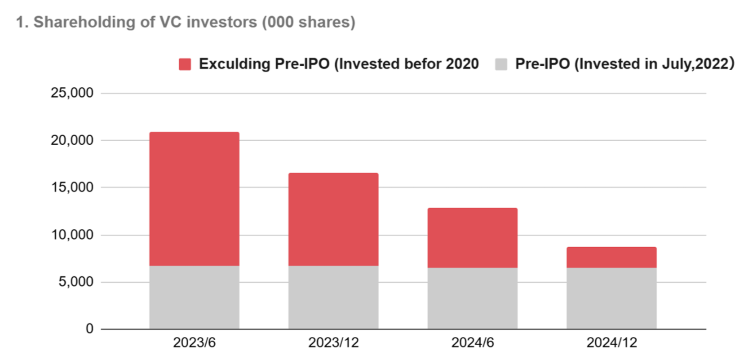 Furthermore, looking at the changes in our shareholder distribution since our IPO (please refer to Graph 2 below), the shares previously held by VC investors have been widely distributed among domestic and international institutional investors. Particularly in the six months leading up to December 2024, shareholdings increased by approximately 2.5 million shares among foreign institutional investors (Note 2) and approximately 2.1 million shares among domestic institutional investors (Note 2). We view this increase in institutional investor holdings as evidence that these investors understand and appreciate our growth potential and business model, and we would like to express our renewed gratitude for their continued support.
Moving forward, we will further strengthen our IR activities to help individual investors, as well as domestic and international institutional investors, better understand our business. We continue to be grateful for the support of all our shareholders and will devote our full efforts toward enhancing sustainable corporate value.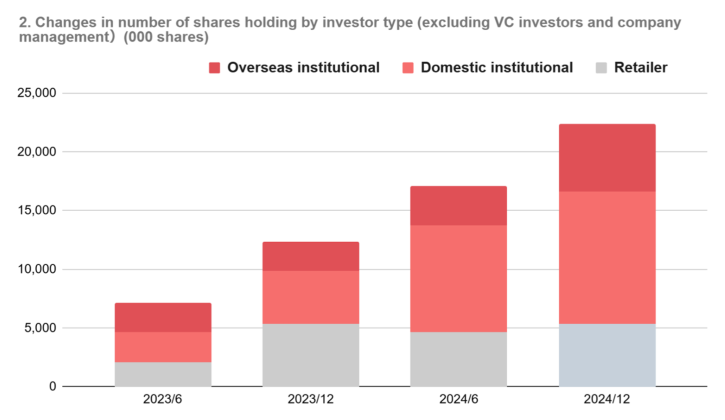 (Note 1) "Overhang" concerns refer to concerns about a potential deterioration in the supply-demand balance of shares due to anticipated large-scale share sales by major shareholders and others in the future.
(Note 2) Domestic institutional investors include general corporations, and foreign institutional investors include some individual investors.
Since our founding, particularly during our pre-IPO period, we have received tremendous support from venture capital and other financial investors (hereinafter referred to as "VC investors"). Through their provision of growth capital and valuable management advice, we recognize that we have been able to establish our business foundation and achieve sustained growth. We would like to take this opportunity to express our deepest gratitude.
Generally, funds operated by venture capital firms have a redemption period of approximately 10 years, and they need to recover their investments (through the sale of acquired shares) after a certain period following their initial investment. Therefore, when there is a significant time gap between pre-IPO fundraising and the actual IPO, a situation known as "overhang" (Note 1) may occur, where share sales either take place or are expected to take place within a relatively short period after the IPO, potentially deteriorating the supply-demand balance of the shares. While stock prices fluctuate due to various factors including market conditions and business performance, a deterioration in the supply-demand balance can be one factor that suppresses stock prices.
In our case, due to our history of active fundraising since our founding, we took steps to mitigate post-IPO overhang concerns in July 2022, just before our IPO, by welcoming new shareholders who both invested in our company and purchased existing shares from shareholders (who had held their investments for a certain period). However, when we went public in March 2023, the overall stock market was weak, which resulted in a limited offering size at IPO, and the liquidity of our shares, both during the initial public offering and afterward, was not sufficient. As a result, we have received multiple concerns from investors regarding the overhang issue after our IPO.
However, looking back at the changes in our shareholder composition since our IPO, our VC investors who invested before the IPO have gradually reduced their shareholdings based on their specific circumstances, including fund redemption deadlines (please refer to Graph 1 below). As a result, as of the end of December 2024, excluding the shares invested in July 2022 just before the IPO (Pre-IPO), both the number of pre-IPO VC investors and the number of shares held by VC investors have already reached limited levels. Furthermore, to the best of our knowledge, we have not identified any major shareholders with intentions to sell shares on a scale that would significantly impact the market, and we believe that shortterm overhang concerns are now limited.
Furthermore, looking at the changes in our shareholder distribution since our IPO (please refer to Graph 2 below), the shares previously held by VC investors have been widely distributed among domestic and international institutional investors. Particularly in the six months leading up to December 2024, shareholdings increased by approximately 2.5 million shares among foreign institutional investors (Note 2) and approximately 2.1 million shares among domestic institutional investors (Note 2). We view this increase in institutional investor holdings as evidence that these investors understand and appreciate our growth potential and business model, and we would like to express our renewed gratitude for their continued support.Moving forward, we will further strengthen our IR activities to help individual investors, as well as domestic and international institutional investors, better understand our business. We continue to be grateful for the support of all our shareholders and will devote our full efforts toward enhancing sustainable corporate value.
(Note 1) "Overhang" concerns refer to concerns about a potential deterioration in the supply-demand balance of shares due to anticipated large-scale share sales by major shareholders and others in the future.(Note 2) Domestic institutional investors include general corporations, and foreign institutional investors include some individual investors.
What are your thoughts on transitioning to the Prime Market?
Disclosed on November 14, 2024
Since our listing on the Growth Market in March 2023, thanks to shareholder support and business growth, we understand that we currently meet all formal requirements for the Prime Market except for the "profit or revenue" criterion. Regarding the "profit or revenue" requirement, there is a criterion of "total profit for the most recent two years must be 2.5 billion yen or more." If we achieve the revised consolidated earnings forecast announced on November 14th for FY2024, we would meet this requirement (based on the total profit for FY2023 and FY2024).
While we have not made any decisions regarding transitioning to the Prime Market at this time, when we meet all requirements for listing on the Prime Market (including non-formal requirements), we will consider it as one of our important management options.
Since our listing on the Growth Market in March 2023, thanks to shareholder support and business growth, we understand that we currently meet all formal requirements for the Prime Market except for the "profit or revenue" criterion. Regarding the "profit or revenue" requirement, there is a criterion of "total profit for the most recent two years must be 2.5 billion yen or more." If we achieve the revised consolidated earnings forecast announced on November 14th for FY2024, we would meet this requirement (based on the total profit for FY2023 and FY2024).
While we have not made any decisions regarding transitioning to the Prime Market at this time, when we meet all requirements for listing on the Prime Market (including non-formal requirements), we will consider it as one of our important management options.
Are measures to improve stock liquidity being considered?
Disclosed on April 1, 2024
After conducting the secondary offering of stock announced in September 2023, the liquidity of our company's stocks has relatively improved, and we have more shareholders holding our stocks. Therefore, we believe that the increase in the floating stock ratio due to the offering has had a certain effect, but we still have not reached the desired level of liquidity. This is not only due to the floating stock ratio but also because we need to improve the recognition of our company and awareness of our business among investors. Therefore, we do not have any plans for stock offerings at this time, and we want to focus on enhancing the recognition of our company for the time being.
In order to ensure that institutional and individual investors fully understand the potential and attractiveness of our business and the Asian market, we are committed to strengthening disclosure and maintaining ongoing communication. We believe it is crucial to build trust from the stock market by demonstrating progress in performance in line with investors' expectations, including achieving disclosed performance forecasts. Therefore, we will continue to strive in our business endeavors, solidifying our business foundation in Asia.
After conducting the secondary offering of stock announced in September 2023, the liquidity of our company's stocks has relatively improved, and we have more shareholders holding our stocks. Therefore, we believe that the increase in the floating stock ratio due to the offering has had a certain effect, but we still have not reached the desired level of liquidity. This is not only due to the floating stock ratio but also because we need to improve the recognition of our company and awareness of our business among investors. Therefore, we do not have any plans for stock offerings at this time, and we want to focus on enhancing the recognition of our company for the time being.
In order to ensure that institutional and individual investors fully understand the potential and attractiveness of our business and the Asian market, we are committed to strengthening disclosure and maintaining ongoing communication. We believe it is crucial to build trust from the stock market by demonstrating progress in performance in line with investors' expectations, including achieving disclosed performance forecasts. Therefore, we will continue to strive in our business endeavors, solidifying our business foundation in Asia.
What is the trading unit for stocks?
The trading unit is 100 shares.
When is the annual general meeting of shareholders?
The annual general meeting of shareholders is held in late March every year.
What are the policy about dividends?
We recognize that while our business continues to grow over the medium to long term, it has transitioned to a stage of stable profit generation. Considering this situation and our business performance, financial position, cash flows, and other factors comprehensively, we announced on May 14, 2025, that we will implement a dividend for the first time. The forecast for the year-end dividend for the fiscal year ending December 2025 is 2.00 yen per share, and we anticipate the same amount for the fiscal year ending December 2026. We aim to maintain stable and continuous dividends while continuing active growth investments in the future. At this point, we have not established a specific dividend payout ratio, but our goal is to increase dividends in accordance with profit growth.
The Company's Articles of Incorporation stipulate that the Company may pay an interim dividend, while the Company's basic policy is to pay dividends from surplus twice a year: an interim dividend and a year-end dividend. In accordance with the provisions of Article 459, Paragraph 1 of the Companies Act, the Company stipulates in its Articles of Incorporation that the Board of Directors shall be the decision-making body for dividends from surplus, except as otherwise provided by laws and regulations.
The Company's Articles of Incorporation stipulate that the Company may pay an interim dividend, while the Company's basic policy is to pay dividends from surplus twice a year: an interim dividend and a year-end dividend. In accordance with the provisions of Article 459, Paragraph 1 of the Companies Act, the Company stipulates in its Articles of Incorporation that the Board of Directors shall be the decision-making body for dividends from surplus, except as otherwise provided by laws and regulations.
Who should I contact to change my address or complete other stock-related procedures?
You should contact the account management institution (securities company) where you have opened your account. Alternatively, you may contact Mitsubishi UFJ Trust and Banking Corporation, the administrator of the shareholders' register. Please refer to the Stock Memo for contact numbers and other information.
About M&A
Is there any further progress on the PMI of the three companies acquired in January?
Disclosed on May 14, 2026
PMI for all three companies is progressing well, with business synergies being generated across multiple areas. In collaboration with Bcode, we conducted a live commerce initiative on TikTok Shop in Japan for "Sunsun Sponge," a brand supported by our Enterprise E-commerce Growth business. Through a partnership with live commerce creators affiliated with Bcode, the initiative delivered over 4,300 sponge units sold across two days and a total of five hours of live streaming, with certain SKUs selling out entirely. These results demonstrate that tangible cross-selling outcomes are already emerging at an early stage.
In collaboration with MISM, within the Publisher Growth business, we have brought in-house the production of creative assets that are effective for app user acquisition. This has enabled us to offer publishers a new end-to-end solution encompassing creative production, ad delivery, performance analysis, and optimization measures. As regulations on targeted advertising continue to tighten, we are now applying data-driven optimization to the creative domain, an area where return on investment has traditionally been difficult to quantify, thereby driving improvements in advertising performance.
In collaboration with SUNSMILE, we have recently launched "AnyAI OMO (Note)," an AI Agent-powered platform that provides end-to-end support for online and offline initiatives, from effectiveness analysis to optimization and execution. This platform combines SUNSMILE's offline distribution network, backed by a proven track record of transactions with over 30,000 stores nationwide, with our expertise in data and AI utilization. Built on a foundation of AI analytics, the platform offers comprehensive support encompassing sales floor proposals, promotional design, and distribution expansion. We have already begun to see early results in a case study with "Advanced Clinicals," a U.S. skincare brand we support. By refining their sales strategy while analyzing the spillover effects of online campaigns on physical retail stores, the combined sales at the targeted stores increased by approximately 1.5 times compared to the previous month.
Going forward, we will continue to strengthen our proprietary cross-channel support framework, which comprehensively covers the spectrum from social marketing to social commerce, and drive further revenue growth through deeper collaboration across the Group.
Note: Online Merges with Offline. An initiative that integrates online and physical stores to deliver a seamless and optimal purchasing experience.
PMI for all three companies is progressing well, with business synergies being generated across multiple areas. In collaboration with Bcode, we conducted a live commerce initiative on TikTok Shop in Japan for "Sunsun Sponge," a brand supported by our Enterprise E-commerce Growth business. Through a partnership with live commerce creators affiliated with Bcode, the initiative delivered over 4,300 sponge units sold across two days and a total of five hours of live streaming, with certain SKUs selling out entirely. These results demonstrate that tangible cross-selling outcomes are already emerging at an early stage.
In collaboration with MISM, within the Publisher Growth business, we have brought in-house the production of creative assets that are effective for app user acquisition. This has enabled us to offer publishers a new end-to-end solution encompassing creative production, ad delivery, performance analysis, and optimization measures. As regulations on targeted advertising continue to tighten, we are now applying data-driven optimization to the creative domain, an area where return on investment has traditionally been difficult to quantify, thereby driving improvements in advertising performance.
In collaboration with SUNSMILE, we have recently launched "AnyAI OMO (Note)," an AI Agent-powered platform that provides end-to-end support for online and offline initiatives, from effectiveness analysis to optimization and execution. This platform combines SUNSMILE's offline distribution network, backed by a proven track record of transactions with over 30,000 stores nationwide, with our expertise in data and AI utilization. Built on a foundation of AI analytics, the platform offers comprehensive support encompassing sales floor proposals, promotional design, and distribution expansion. We have already begun to see early results in a case study with "Advanced Clinicals," a U.S. skincare brand we support. By refining their sales strategy while analyzing the spillover effects of online campaigns on physical retail stores, the combined sales at the targeted stores increased by approximately 1.5 times compared to the previous month.
Going forward, we will continue to strengthen our proprietary cross-channel support framework, which comprehensively covers the spectrum from social marketing to social commerce, and drive further revenue growth through deeper collaboration across the Group.
Note: Online Merges with Offline. An initiative that integrates online and physical stores to deliver a seamless and optimal purchasing experience.
You announced the M&A of Bcode and MISM in January 2026; please explain the synergies of each business.
Disclosed on February 13, 2026
The M&A of Bcode and MISM, similar to Sun Smile, which began consolidation in January 2026, is aimed at strengthening the overall portfolio of the Enterprise Growth Business. In recent years, the behavioral shift from information contact to purchase driven by social media and video platforms has accelerated, and we are capturing this trend and positioning the establishment of competitive advantages in the social media marketing and social commerce areas as central to our strategy.
Through these M&A deals, we have established a structure capable of providing integrated end-to-end support for enterprises from demand creation to purchase conversion, and further to offline distribution.
First, MISM serves as a stable supplier of high-quality creative content through its vertical video production capabilities and stock video platform. In particular, its strength lies in providing materials with cleared usage rights and a model network to major clients where compliance is critical, thereby solidifying support for demand generation across social media channels.
Next, Bcode strengthens the purchase conversion function in the live commerce area through support for live streamers centered on TikTok LIVE. By integrating Bcode's live streamer network with our existing businesses, we can expand new sales channels originating from live streaming.
Furthermore, through the consolidation of Sun Smile, we have integrated an offline distribution network spanning over 30,000 stores in Japan. By combining our online demand creation and sales support with sales deployment in physical stores, we are establishing an integrated, end-to-end support structure for enterprises, from generating buzz on social media to in-store sales.
All of these M&A deals are aimed at responding to new consumer behavior that extends from social media awareness to purchase, and at enhancing competitiveness in marketing and commerce support. Going forward, our policy is to continue disciplined M&A on the premise of synergies with existing businesses centered on the Enterprise Growth Business.
The M&A of Bcode and MISM, similar to Sun Smile, which began consolidation in January 2026, is aimed at strengthening the overall portfolio of the Enterprise Growth Business. In recent years, the behavioral shift from information contact to purchase driven by social media and video platforms has accelerated, and we are capturing this trend and positioning the establishment of competitive advantages in the social media marketing and social commerce areas as central to our strategy.
Through these M&A deals, we have established a structure capable of providing integrated end-to-end support for enterprises from demand creation to purchase conversion, and further to offline distribution.
First, MISM serves as a stable supplier of high-quality creative content through its vertical video production capabilities and stock video platform. In particular, its strength lies in providing materials with cleared usage rights and a model network to major clients where compliance is critical, thereby solidifying support for demand generation across social media channels.
Next, Bcode strengthens the purchase conversion function in the live commerce area through support for live streamers centered on TikTok LIVE. By integrating Bcode's live streamer network with our existing businesses, we can expand new sales channels originating from live streaming.
Furthermore, through the consolidation of Sun Smile, we have integrated an offline distribution network spanning over 30,000 stores in Japan. By combining our online demand creation and sales support with sales deployment in physical stores, we are establishing an integrated, end-to-end support structure for enterprises, from generating buzz on social media to in-store sales.
All of these M&A deals are aimed at responding to new consumer behavior that extends from social media awareness to purchase, and at enhancing competitiveness in marketing and commerce support. Going forward, our policy is to continue disciplined M&A on the premise of synergies with existing businesses centered on the Enterprise Growth Business.
It was mentioned that business for enterprise has been strengthened following the consolidation of SUNSMILE announced in December 2025. Could you provide more details regarding the synergies with the current business portfolio?
Disclosed on January 7, 2026
Following the consolidation of SUNSMILE, our business for enterprise has evolved into a system capable of providing integrated support from social media-driven demand generation to sales in e-commerce and offline retail. This addition of offline distribution functions, including physical stores, to our business portfolio, which was previously centered on online channels, significantly expands our scope of support.
The specific synergies consist primarily of the following two points.
First is the acquisition of a sales network that spans both online and offline channels. While we have previously provided sales support mainly in e-commerce through social media marketing and social commerce, leveraging SUNSMILE's retail distribution network, mainly in variety stores, has enabled us to provide support that links online demand generation to offline sales. Particularly in the beauty and personal care sectors, where consumer behavior from information exposure on social media to purchase is well-established, we believe that an integrated online and offline support system will be a significant competitive advantage. For details, please refer to the diagram below and the timely disclosure material titled "Regarding SUNSMILE INC. Joining AnyMind Group" published on December 18, 2025.
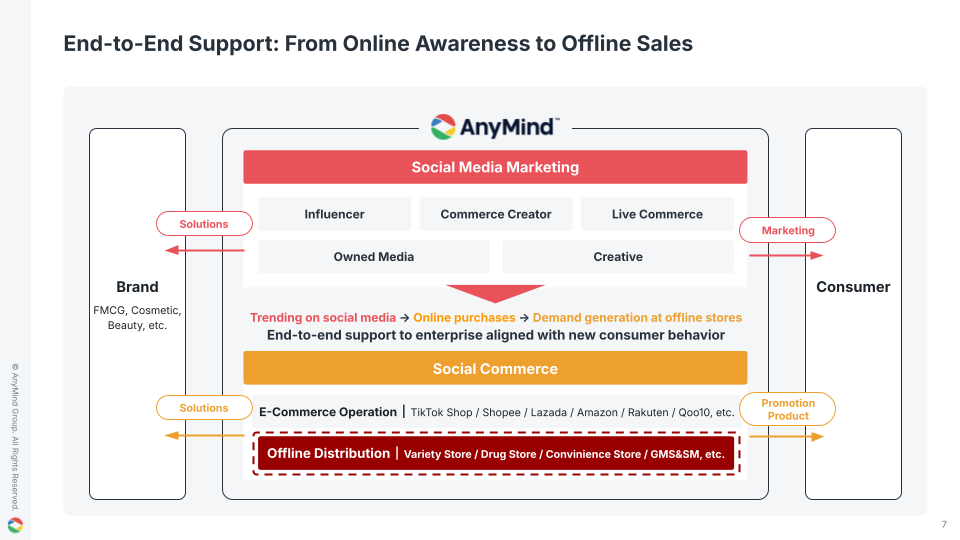
Second is the expansion of cross-selling opportunities for existing enterprise clients and brands. We can now offer our existing enterprise clients integrated support proposals that include offline distribution in addition to e-commerce. Furthermore, brands handled by SUNSMILE, such as beauty accessories and Korean cosmetics, are expected to grow by leveraging our e-commerce operations and marketing expertise. We believe this will lead to an improvement in revenue per enterprise client and per brand.
Additionally, NADESHIKO Beauty, which joined the group in October 2025, complements these efforts by handling the awareness and purchase consideration phases through its own media operations, primarily on TikTok. By combining their media operational capabilities with SUNSMILE's offline network and integrating the entire process as AnyMind Group, we will further strengthen our social media-driven support system for business for enterprise.
Based on our deep understanding of business customs and e-commerce/marketing practices across Asia, we have built a comprehensive support system that spans marketing and commerce. We believe that such a structure is not easily replicated in a short period, and we aim to establish our position as a key partner in business for enterprise within the social media marketing and social commerce fields in Asia.
Following the consolidation of SUNSMILE, our business for enterprise has evolved into a system capable of providing integrated support from social media-driven demand generation to sales in e-commerce and offline retail. This addition of offline distribution functions, including physical stores, to our business portfolio, which was previously centered on online channels, significantly expands our scope of support.
The specific synergies consist primarily of the following two points.
First is the acquisition of a sales network that spans both online and offline channels. While we have previously provided sales support mainly in e-commerce through social media marketing and social commerce, leveraging SUNSMILE's retail distribution network, mainly in variety stores, has enabled us to provide support that links online demand generation to offline sales. Particularly in the beauty and personal care sectors, where consumer behavior from information exposure on social media to purchase is well-established, we believe that an integrated online and offline support system will be a significant competitive advantage. For details, please refer to the diagram below and the timely disclosure material titled "Regarding SUNSMILE INC. Joining AnyMind Group" published on December 18, 2025.
Second is the expansion of cross-selling opportunities for existing enterprise clients and brands. We can now offer our existing enterprise clients integrated support proposals that include offline distribution in addition to e-commerce. Furthermore, brands handled by SUNSMILE, such as beauty accessories and Korean cosmetics, are expected to grow by leveraging our e-commerce operations and marketing expertise. We believe this will lead to an improvement in revenue per enterprise client and per brand.
Additionally, NADESHIKO Beauty, which joined the group in October 2025, complements these efforts by handling the awareness and purchase consideration phases through its own media operations, primarily on TikTok. By combining their media operational capabilities with SUNSMILE's offline network and integrating the entire process as AnyMind Group, we will further strengthen our social media-driven support system for business for enterprise.
Based on our deep understanding of business customs and e-commerce/marketing practices across Asia, we have built a comprehensive support system that spans marketing and commerce. We believe that such a structure is not easily replicated in a short period, and we aim to establish our position as a key partner in business for enterprise within the social media marketing and social commerce fields in Asia.
The acquisition of shares in SUNSMILE is large-scale compared to past projects, and the funds for this project will be allocated from borrowings. Given the premise of continuing M&A in the future, are you considering financing methods other than financial institutions, such as a public offering?
Disclosed on January 7, 2026
At this time, we are not considering any specific plans for equity financing, such as public offerings, as our basic policy is to raise funds by utilizing our borrowing capacity.
Borrowings for this share acquisition will amount to approximately 4.1 billion yen. However, as of the end of September 2025, we held approximately 3.1 billion yen in net cash, and we recognize that financial leverage remains at an appropriate level even after the acquisition. We will continue to maintain a capital policy that emphasizes a balance between financial soundness and growth investment.
Furthermore, we believe there is sufficient backing in terms of profitability. The Company's consolidated operating profit forecast for the fiscal year ending 2025 is 1.7 billion yen. In addition, SUNSMILE, which will be consolidated starting January 2026, recorded an actual operating profit of 670 million yen (IFRS basis) for the most recent 12 months as of the end of June 30, 2025, provided here as a reference value. By consolidating a business with a solid earnings base, we expect profit levels to steadily increase.
Based on these factors, we believe that even after the current borrowing, we have secured a sufficient financial foundation and borrowing capacity for future growth investments. Regarding future financing, our policy is to consider the optimal means while taking share dilution and the impact on existing shareholder value into full consideration.
At this time, we are not considering any specific plans for equity financing, such as public offerings, as our basic policy is to raise funds by utilizing our borrowing capacity.
Borrowings for this share acquisition will amount to approximately 4.1 billion yen. However, as of the end of September 2025, we held approximately 3.1 billion yen in net cash, and we recognize that financial leverage remains at an appropriate level even after the acquisition. We will continue to maintain a capital policy that emphasizes a balance between financial soundness and growth investment.
Furthermore, we believe there is sufficient backing in terms of profitability. The Company's consolidated operating profit forecast for the fiscal year ending 2025 is 1.7 billion yen. In addition, SUNSMILE, which will be consolidated starting January 2026, recorded an actual operating profit of 670 million yen (IFRS basis) for the most recent 12 months as of the end of June 30, 2025, provided here as a reference value. By consolidating a business with a solid earnings base, we expect profit levels to steadily increase.
Based on these factors, we believe that even after the current borrowing, we have secured a sufficient financial foundation and borrowing capacity for future growth investments. Regarding future financing, our policy is to consider the optimal means while taking share dilution and the impact on existing shareholder value into full consideration.
Please provide details on the purpose and synergies of the acquisition of NADESIKO Inc.
Disclosed on October 1, 2025
The acquisition of NADESIKO Inc., announced on August 29, is intended to create cross-selling and up-selling opportunities, particularly for our clients in the beauty and cosmetics sector. NADESIKO operates a beauty-focused media outlet that is popular mainly among Gen Z women and is growing rapidly, primely through TikTok. As both companies have similar client bases, we believe we can generate business synergies immediately after its joining to our group, and we expect to further accelerate their business growth by leveraging our sales capabilities for their operations, which have previously centered on acquiring new clients through inquiries. Please note that NADESIKO's financial results will be consolidated from the fourth quarter.
Through this collaboration, we first aim to establish a leading position in the beauty social media category. Furthermore, by combining the content capabilities of the media operated by NADESIKO with our sales force and technology, we will fully embark on building a new revenue model. Specifically, we will promote social commerce utilizing platforms such as TikTok Shop and the monetization of review content through affiliate programs. Additionally, by leveraging our live commerce platform "AnyLive," we will create a seamless experiential value that connects social media videos to live streaming and, ultimately, to purchases.
We also believe that NADESIKO's business model has low reliance on specific individuals and is easily expandable overseas. We plan to sequentially expand this successful model to Southeast Asia, where our business foundation is established. With NADESIKO joining the network of our influencer marketing platform "AnyTag" and "GROVE," which owns a beauty influencer label, we will establish a marketing structure that broadly covers target users in the beauty and lifestyle sector. This will allow us to further contribute to the growth of our clients who operate in this sector.
The acquisition of NADESIKO Inc., announced on August 29, is intended to create cross-selling and up-selling opportunities, particularly for our clients in the beauty and cosmetics sector. NADESIKO operates a beauty-focused media outlet that is popular mainly among Gen Z women and is growing rapidly, primely through TikTok. As both companies have similar client bases, we believe we can generate business synergies immediately after its joining to our group, and we expect to further accelerate their business growth by leveraging our sales capabilities for their operations, which have previously centered on acquiring new clients through inquiries. Please note that NADESIKO's financial results will be consolidated from the fourth quarter.
Through this collaboration, we first aim to establish a leading position in the beauty social media category. Furthermore, by combining the content capabilities of the media operated by NADESIKO with our sales force and technology, we will fully embark on building a new revenue model. Specifically, we will promote social commerce utilizing platforms such as TikTok Shop and the monetization of review content through affiliate programs. Additionally, by leveraging our live commerce platform "AnyLive," we will create a seamless experiential value that connects social media videos to live streaming and, ultimately, to purchases.
We also believe that NADESIKO's business model has low reliance on specific individuals and is easily expandable overseas. We plan to sequentially expand this successful model to Southeast Asia, where our business foundation is established. With NADESIKO joining the network of our influencer marketing platform "AnyTag" and "GROVE," which owns a beauty influencer label, we will establish a marketing structure that broadly covers target users in the beauty and lifestyle sector. This will allow us to further contribute to the growth of our clients who operate in this sector.
Could you please provide information about the future direction regarding M&A?
Disclosed on April 2, 2025 (Revised based on May 14, 2025 disclosure)
We analyze business and growth opportunities along two axes - business and region - and strategically utilize M&A. Our main objectives are to acquire management teams, talent, and local networks, with a focus on strengthening organizational capabilities and business foundations.
Since our foundation, we have completed over 10 M&A deals in both Japan and overseas and have focused on creating synergies through business integration post-acquisition. Comparing sales immediately after acquisition to December 2024, we have achieved an average growth of 4.4 times. While previously based on approximately 1-2 deals annually, we are considering gradually increasing this pace going forward.
Current priority areas are enterprise e-commerce and related peripheral businesses, focusing on companies that are already generating revenue while balancing risk. Regarding financing, with a low D/E ratio of 0.2 times as of the end of 2024, continue to consider financing primarily through interest-bearing debt.
We analyze business and growth opportunities along two axes - business and region - and strategically utilize M&A. Our main objectives are to acquire management teams, talent, and local networks, with a focus on strengthening organizational capabilities and business foundations.
Since our foundation, we have completed over 10 M&A deals in both Japan and overseas and have focused on creating synergies through business integration post-acquisition. Comparing sales immediately after acquisition to December 2024, we have achieved an average growth of 4.4 times. While previously based on approximately 1-2 deals annually, we are considering gradually increasing this pace going forward.
Current priority areas are enterprise e-commerce and related peripheral businesses, focusing on companies that are already generating revenue while balancing risk. Regarding financing, with a low D/E ratio of 0.2 times as of the end of 2024, continue to consider financing primarily through interest-bearing debt.
What is your company's policy, if any, when considering M&A, and what is your policy for reducing risks related to M&A?
Disclosed on May 12, 2023
The following are points of focus when conducting M&As:
1. Resolution/deep understanding for the target business
Our basic policy is to consider M&A in a manner that complements existing businesses and business domains. Therefore, when considering M&A, we believe that having a high resolution of the business environment, business model, and risks and opportunities of the target business will form the basis for various discussions, including management synergies and business integration.
2. Direction and culture fit with the target company's management members
In principle, our M&A activities are based on the premise of business integration, and the objective is often to acquire organizations, networks, etc., through M&A. One of these is the acquisition of talented management members, and we aim to strengthen our own management structure by having people with extensive management experience join us through M&A. In the process of conducting M&A, we hold discussions with the target company's management team to gain a mutual understanding of not only the business of both companies, but also the direction and values that the management team is aiming for as individuals. We also believe that having the target company's management team makes the integration process effective in accelerating the process.
3. Possibility of multiple synergies across different time periods
When conducting M&A activities, it is important that we assume synergies between the two companies. In many cases, we can expect immediate synergies based on our network, organization and technology (e.g., cross-border initiatives, etc.), since we are constantly expanding into multiple business areas and businesses. We also believe that it is desirable to be able to envision as many synergistic scenarios as possible, and to strike a balance between synergies that can be realized immediately and synergies that are expected to occur over the longer term.
In addition, we take the following measures to reduce the risks involved in the M&A process, which has inherent elements of uncertainty.
1. Proactive business integration after M&A
In principle, we aim to quickly unify the governance structure and granularity of business management, by proactively integrating organizations, businesses and systems after M&A, and integrate them into our business management system and structure. We view this as an important step to ensure stable growth of the Group over the medium to long term by creating synergies, identifying business risks and opportunities, and aligning corporate culture through business integration.
2. Implement a multifaceted due diligence process prior to M&A
When implementing M&A, our internal policy is to appoint local advisors for financial, tax, and legal due diligence, as well as valuation evaluation of the target company, and conduct analysis based on the risks and constraints unique to each country. In addition, as part of the process of deepening our understanding of the business, our team and management team will conduct due diligence on the business to assess the probability of the business plan and growth potential and risks of the business model. Through this multifaceted evaluation process, we understand the risk associated with the target business and verify the possibility of business integration.
The following are points of focus when conducting M&As:
1. Resolution/deep understanding for the target business
Our basic policy is to consider M&A in a manner that complements existing businesses and business domains. Therefore, when considering M&A, we believe that having a high resolution of the business environment, business model, and risks and opportunities of the target business will form the basis for various discussions, including management synergies and business integration.
2. Direction and culture fit with the target company's management members
In principle, our M&A activities are based on the premise of business integration, and the objective is often to acquire organizations, networks, etc., through M&A. One of these is the acquisition of talented management members, and we aim to strengthen our own management structure by having people with extensive management experience join us through M&A. In the process of conducting M&A, we hold discussions with the target company's management team to gain a mutual understanding of not only the business of both companies, but also the direction and values that the management team is aiming for as individuals. We also believe that having the target company's management team makes the integration process effective in accelerating the process.
3. Possibility of multiple synergies across different time periods
When conducting M&A activities, it is important that we assume synergies between the two companies. In many cases, we can expect immediate synergies based on our network, organization and technology (e.g., cross-border initiatives, etc.), since we are constantly expanding into multiple business areas and businesses. We also believe that it is desirable to be able to envision as many synergistic scenarios as possible, and to strike a balance between synergies that can be realized immediately and synergies that are expected to occur over the longer term.
In addition, we take the following measures to reduce the risks involved in the M&A process, which has inherent elements of uncertainty.
1. Proactive business integration after M&A
In principle, we aim to quickly unify the governance structure and granularity of business management, by proactively integrating organizations, businesses and systems after M&A, and integrate them into our business management system and structure. We view this as an important step to ensure stable growth of the Group over the medium to long term by creating synergies, identifying business risks and opportunities, and aligning corporate culture through business integration.
2. Implement a multifaceted due diligence process prior to M&A
When implementing M&A, our internal policy is to appoint local advisors for financial, tax, and legal due diligence, as well as valuation evaluation of the target company, and conduct analysis based on the risks and constraints unique to each country. In addition, as part of the process of deepening our understanding of the business, our team and management team will conduct due diligence on the business to assess the probability of the business plan and growth potential and risks of the business model. Through this multifaceted evaluation process, we understand the risk associated with the target business and verify the possibility of business integration.